

Hire the wrong pool liner installer, and you’ll know within a season. Wrinkles. A leak that wasn’t there in October. A drainage issue nobody mentioned during the estimate. Then the calls back and forth, we’ll get someone out next week, while your pool sits half-empty.
We’ve seen it more times than we’d like. Honestly, most of the worst pool jobs we get called in to fix didn’t fail because of bad materials. They failed because the right questions never got asked up front.
This guide walks through the questions that actually matter, the red flags we wish more homeowners caught before signing, and what’s specific about pool liner work in Massachusetts and New Hampshire that out-of-state advice tends to miss. It’s written from 13+ years of doing this work across MA and southern NH, towns like Andover, Bedford, Tewksbury, Nashua, Pelham, and Windham, so the examples are local, not theoretical.
Questions to Ask Before Hiring a Pool Liner Installer
The first phone call tells you almost everything. A solid contractor talks about your site, your conditions, and your concerns. They ask questions back. A weak one cuts straight to what’s your budget? and tries to lock in a number before they’ve even seen the yard. That difference shows up later, in the work itself.
Question one, and this one’s big, how long have they been doing vinyl liner work specifically? The pool building experience overall is great. But liner replacement is its own animal. Measurements need to be exact. A half-inch wrong and you’ve got wrinkles by July. It’s precision work, and a guy who built ten gunite pools last year hasn’t necessarily installed many liners.
Then there’s licensing and insurance. Both states require coverage, but plenty of small operators bend the rules. Ask for proof, and Massachusetts homeowners can also review the state’s Home Improvement Contractor Registration guidance before hiring.
Real proof, a current certificate emailed to you, not a verbal, yeah, we’re covered. Liability and workers’ comp matter most. If somebody gets hurt on your property and there’s no comp coverage, that’s your homeowner’s policy on the line. Big mistake.
In-house crews or subs? This one catches people off guard. Some companies are essentially brokers; they sell the job and farm out every phase. The crew installing your liner might be meeting you that morning. Other shops keep dedicated teams who do this every week, follow the same standards, and know each other’s habits. The second kind tends to produce cleaner work. Worth asking outright.
What does the pre-installation inspection look like? A real one means walking the pool, checking wall panels, looking at the floor for cracks or settling, examining coping, peeking at plumbing fittings, and walking the surrounding grade. The quicker we’ll figure it out when we drain it, answer? Run. That’s how you end up with $1,200 in change orders the day they pull the old liner.
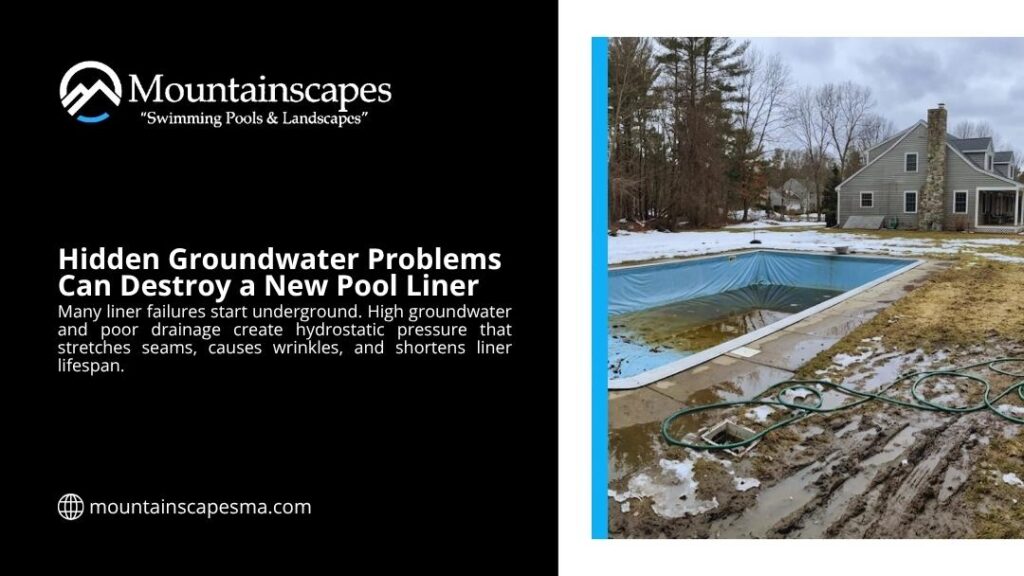
Drainage is the question almost nobody asks. And it’s the one that decides whether your new liner lasts seven years or two. New England soil holds water. Spring snowmelt and heavy rain create hydrostatic pressure underneath the pool, which is the force that pushes liners into floating or shifts seams over time. The EPA explains that stormwater runoff comes from rain and snowmelt that flows over land instead of soaking into the ground.
A contractor who doesn’t bring this up isn’t thinking long-term about your pool. Anyone dealing with soggy lawn spots or standing water near the patio should look at the signs that your backyard needs a drainage system before scheduling any liner work.
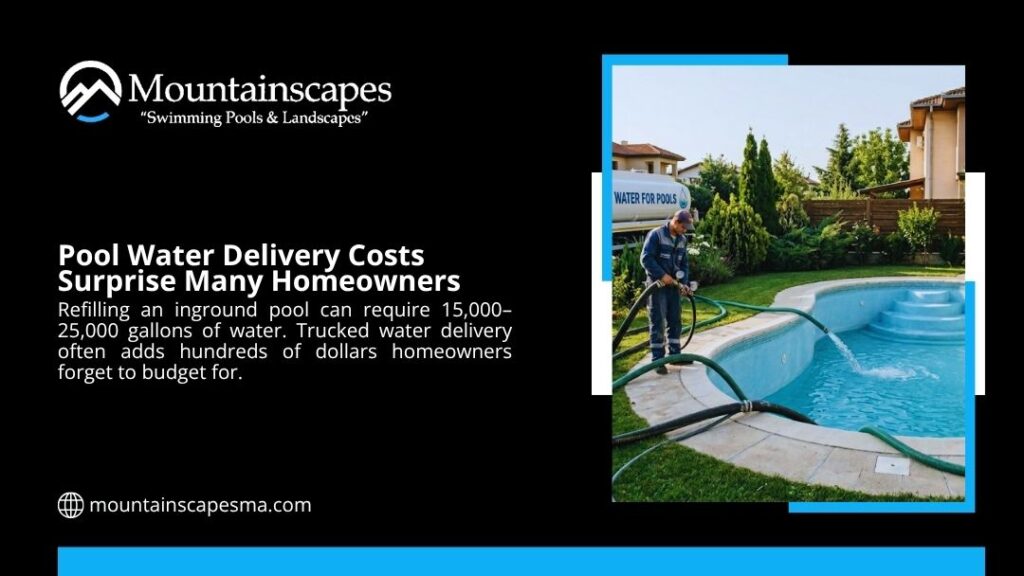
Pricing, push past the headline number. The cheapest quote rarely stays cheapest. The question to ask is what’s not in this estimate? Wall repairs if rust shows up. Floor patching if there’s settling. Water delivery (your bill if you fill from a hose, easily $400–$800 from a truck). Disposal of the old liner. Coping adjustments. Permits, if your town requires them. The lowest bid is often lowest because half the project lives in extras.
Then there’s timing. Spring is chaos in this industry up here. Every reputable shop is booked solid by late March. A contractor who promises you can be swimming in two weeks during peak season is either lying or about to disappoint another customer to fit you in. Neither is great.
| Question | Why It Matters |
| How many liners have you installed in the last two seasons? | Confirms current, hands-on experience |
| Can I see your insurance certificates? | Protects your homeowner’s liability |
| Do you inspect walls and floors before ordering the liner? | Catches hidden damage early |
| What warranties come with this, and what’s specifically excluded? | Clarifies real long-term protection |
| Who handles excavation and drainage if it’s needed? | Prevents finger-pointing later |
| What’s not in this estimate? | Reduces surprise costs |
| What’s a realistic timeline given your current schedule? | Filters out overbookers |
| Can I see two or three local projects you finished last year? | Verifies workmanship |
Why Pool Liner Installations Fail Earlier Than Expected
Material quality gets all the attention. Installation quality is where most failures actually happen. We get called in for early liner failures all the time, and nine times out of ten, the cause is something that happened during install, not something wrong with the vinyl itself.
Measurements top the list. A liner that’s even slightly off pulls hard at the seams. We had a job last spring in Tyngsboro where the previous installer’s measurements were off by less than an inch in the deep end. Took eighteen months for the seam to give. The customer thought the liner was defective. It wasn’t.
Drainage is right behind it. Water building up under a pool shell from poor site grading? That pressure has to go somewhere. Usually, it pushes the liner up, which people call a floating liner. Once that happens, you’re looking at draining, refitting, or sometimes a full replacement, depending on how long it sat.
Ground movement plays a role, too. Plenty of older pools across MA and NH were installed before grading standards tightened up. Soil settles. Slopes shift. Water finds new paths. Contractors who know how to read a backyard catch this stuff before they order the liner. The ones who don’t, won’t.
And then there’s plain rushed work. Debris left under the liner. Wall panels that should have been replaced. Skipped vacuum sealing during install. None of it shows for a while. Then it does.
If your current liner is showing signs of age and you’re trying to decide between patching or replacing, knowing when to replace your pool liner comes down to recognizing key warning signs like leaks, fading, or brittleness.
How to Choose a Pool Builder That Handles More Than Just the Pool
Most homeowners search for a pool guy. That framing is the problem. A backyard isn’t a pool plus some grass around it. It’s one connected system: drainage, grading, hardscape, retaining walls, lighting, lawn, irrigation, plantings, and the pool.
Every piece affects the others. Bad grading sends water into the pool. A failing retaining wall shifts soil under the deck. An irrigation line buried under the patio springs a leak nobody notices until the coping starts moving.
Hire it out in pieces, and you end up coordinating six different companies that each blame the other one. We see this all the time on rescue jobs.
That’s why design-build contractors have gotten popular. One team. One plan. One person is responsible when something goes sideways. Permitting moves faster because the same shop is already working with town offices on the rest of the project. Scheduling actually holds because there’s no waiting on three subs.
That’s how Mountainscapes is set up. Excavation, grading, drainage, masonry, hardscape, landscape, lighting, pool work, all in-house. You’re not chasing five contractors. You’re talking to one. It’s the way Chris built the company on purpose, and it’s why most of our clients end up doing more than just the pool with us.
If you’re starting to think the pool project is bigger than just a liner, our pool services and landscape construction services lay out what’s possible under one roof.
Hidden Costs Homeowners Often Miss
Liner replacement quotes can swing $1,500 to $3,000 once the old liner comes out and the real story shows up. That’s not contractor games (most of the time). It’s just how older pools work. You don’t know what’s behind the vinyl until you look.
| Potential Cost | Why It Comes Up |
| Pool wall repair | Rust or panel damage hidden behind the old liner |
| Floor repair | Cracks, settling, broken vermiculite |
| Drainage upgrades | Hydrostatic pressure is causing recurring issues |
| Patio adjustments | Existing hardscape has shifted with the pool |
| Water delivery | A typical inground holds 15,000–25,000 gallons |
| Plumbing updates | Old skimmer/return lines fail pressure tests |
| Coping replacement | Edge stones unstable or worn |
One more thing worth noting: plenty of clients use the liner project as the moment to finally fix the patio they’ve been ignoring. Stone vs. concrete is the usual debate.
Red Flags That Suggest a Pool Contractor May Not Be Reputable
You don’t usually realize you’ve hired the wrong contractor until the job is mid-stride. By then, it’s expensive to switch, and the bad contractor knows it. The warning signs are almost always there during the estimate phase. You just have to know what to look for.
A solid contractor will explain warranties, walk through realistic timelines, and bring up drainage even when you didn’t. A weak one stays vague, dodges paperwork questions, and tries to close the deal that same day.
| Red Flag | What It Usually Tells You |
| Verbal-only pricing or ballpark numbers | You’ll see surprise charges once work starts |
| Won’t email proof of insurance | Liability falls on you if something goes wrong |
| “We can start next week” during peak season | Either overbooked or pulling crews from other jobs |
| Wants 50%+ deposit before work begins | Standard is 25–35% in this region |
| Skips the drainage and grading conversation | Doesn’t think long-term about your pool |
| Hard to reach during the estimate phase | Worse during construction, guaranteed |
| Vague warranty answers | Usually means there’s no real warranty |
| Few completed local projects to show | Reference photos are the easiest thing to share if you’ve got them |
| Sign today, and I’ll knock 10% off. | High-pressure tactics are a contractor’s smell test |
| Quoted without inspecting the walls or floor | Hidden damage will become “extras” later |
One tell that’s worth taking seriously: how they handle a hard question. Ask them directly about a previous job that didn’t go well. A confident contractor has a story and what they learned from it. A risky one gets defensive. Try it.
For homeowners checking workmanship locally, our gallery shows finished pool and landscape projects across MA and NH.
What Homeowners in Massachusetts and New Hampshire Should Know Before Pool Season
New England runs on a different pool calendar than the rest of the country. Most reputable shops up here are booked solid by mid-March. If you’re calling in May hoping for a June install, you’re already late. The honest answer most of us give is: we can probably get to you by August, and people don’t love that.
Late January through February is the sweet spot. Schedule the inspection. Lock in the liner order before manufacturers get backed up. Prep work can happen as soon as the ground thaws.
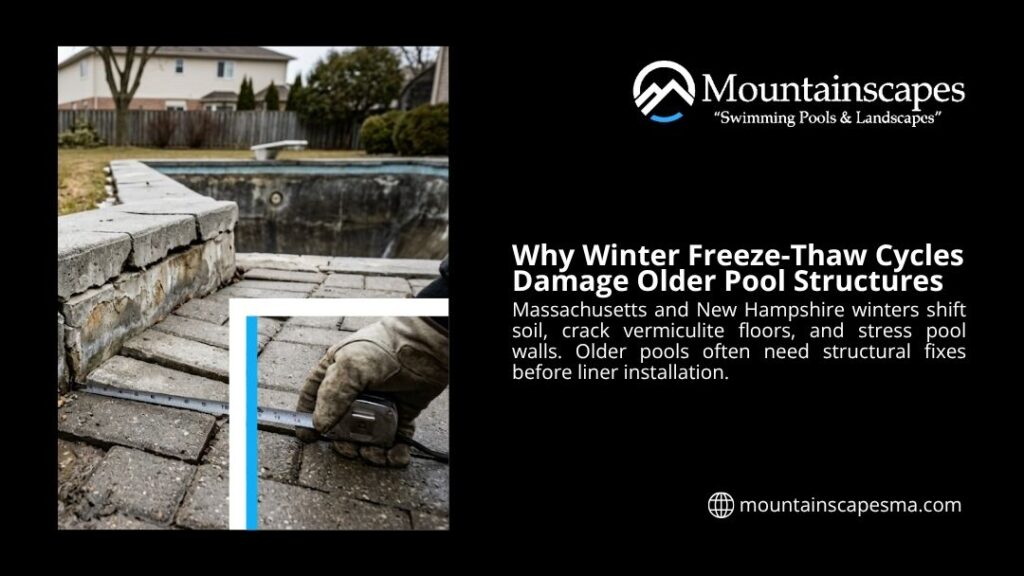
Freeze-thaw is the variable nobody from out of state really gets. Soil moves. Groundwater rises and falls. Ice pressure pushes against the pool walls all winter. Older pools that have been through 15+ winters often need more than just a liner, sometimes wall panels, sometimes coping, sometimes a grading correction. You don’t always know until spring opens the cover.
Snowmelt season is when drainage problems show themselves. A yard that drains fine in July might be a swamp the second week of April. If you’re seeing standing water near the pool, around the patio, or in low spots in the lawn, that’s a flag worth catching before you spend on a new liner.
For homeowners weighing whether the bigger investment makes sense, this piece on whether a pool increases home value gets into the resale numbers we see in MA and NH specifically.
Questions People Forget to Ask About Backyard Conditions
A pool doesn’t live in isolation. It sits inside a yard. The yard is doing things, settling, draining, growing roots, holding water, that affect the pool whether anyone’s paying attention or not. The questions below are the ones that rarely come up during pool estimates. Which is exactly why they matter.
| Backyard Question | Why It Matters for the Pool |
| Where does runoff go after a heavy rain? | Standing water near the pool creates pressure under the liner |
| Are there mature trees within 15 feet? | Roots can shift coping, decks, and pool walls over time |
| What’s the slope of the yard around the pool? | A bad grade sends water toward the pool instead of away |
| Where do the irrigation lines run? | Hidden lines get cut during excavation if not mapped |
| Is groundwater a known issue in this neighborhood? | High water table = constant hydrostatic pressure |
| Are the patio, deck, or coping moving? | Existing shift usually points to a deeper site issue |
| Does the lighting plan need updating now? | Way cheaper to do during the dig than after the new liner |
| Are retaining walls or slopes holding? | Failing walls shift soil under the pool over time |
| How does winter snowmelt drain? | Saturation tells you what summer doesn’t |
| Will any nearby structures need work soon? | Coordinate now or pay double later |
This is the part where having one contractor who actually looks at the whole yard pays for itself. A pool guy is going to install a pool. A design-build team is going to ask why the southwest corner of the yard is wet in April and whether that’s going to chew through the new liner in three seasons.
If outdoor lighting is part of the conversation, understanding how to light a backyard without making it look overdone is worth a quick read while you’re in planning mode.
Pool Liner Installation Timeline Explained
Pool liner projects don’t happen overnight. Anyone who tells you otherwise is probably skipping a step. The typical job runs four to eight weeks from first call to first swim, and most of that wait is on liner manufacturing. Custom liners aren’t sitting in a warehouse; they’re built to your pool’s exact dimensions after measurements are confirmed.
| Phase | Realistic Timeline |
| Initial consultation and quote | 2–5 days |
| On-site inspection and final measurements | Within 1 week |
| Custom liner manufactured | 2–6 weeks (longer in spring) |
| Pool prep and old liner removal | 1–2 days |
| New liner installation | 1–2 days |
| Water fill, chemistry balance, startup | 2–4 days |
The weather throws this off more than people expect. Heavy spring rain delays prep. Cold snaps push back installs. Tankers run behind during peak fill season. Worth asking the contractor up front: how do you handle weather delays, and who calls whom? A good answer is “we’ll text you the day before with any change.” A bad answer is silence.
What Separates a Reputable Pool Contractor From a Risky One
Not every pool builder works the same way. The good ones treat the project like a long-term investment in your property. They explain things you didn’t ask about. They walk the yard. They mention drainage before you bring it up. The risky ones focus on closing the sale and figure out the rest later.
| Reputable Contractor | Risky Contractor |
| Detailed written estimate, line-itemed | Vague verbal pricing, “we’ll figure it out.” |
| Insurance certificates emailed without asking twice | Insurance, “yeah, we have it, somewhere.” |
| Talks about drainage and grading in the first meeting | Avoids the topic entirely |
| Realistic timelines, even if they’re not what you wanted to hear | Whatever timeline closes the sale |
| Written warranty with specifics | “We stand behind our work” with nothing in writing |
| Local projects you can see or drive past | Generic stock photos or no portfolio |
| Returns calls and texts within a day | Disappears for a week mid-estimate |
The biggest tell, in our experience? A reputable contractor doesn’t mind walking away from a job that isn’t a fit. They’ll tell you when something’s outside their wheelhouse, when your timeline isn’t realistic, or when your budget needs to flex. Risky contractors say yes to everything. Then they cut corners to deliver on promises they shouldn’t have made.
This is the entire reason Mountainscapes is built around the design-build model, pool, landscape, drainage, hardscape, masonry, and lighting, all under one team. One company on the hook means nobody to point fingers at when something needs to be made right.
Frequently Asked Questions
How long does a pool liner usually last?
Eight to fifteen years, depending on water chemistry, install quality, drainage, and how brutal your winters have been. Up here? Plan on the lower half of that range. Massachusetts and New Hampshire winters are simply harder on vinyl than the climates most lifespan estimates assume.
What causes wrinkles in a pool liner?
Usually one of three things: groundwater pressure pushing up from below, a measurement error during installation, or shifting soil under the pool. Wrinkles aren’t always a sign of a bad liner; sometimes they’re a sign of a yard that needs drainage work.
Should the pool coping be replaced with the liner?
Not always. But it’s the right time to look at it. Coping is much easier to swap when the pool is being worked on anyway. If your coping has any cracks, gaps, or visible movement, getting it done now saves a separate mobilization fee later.
Can drainage problems damage a pool liner?
Yes, and it’s one of the most underestimated causes of early liner failure in this region. Hydrostatic pressure beneath the pool floor and behind the walls slowly stresses seams and corners. A liner that should’ve lasted twelve years can fail in five if the drainage is off.
How much does pool liner replacement cost in Massachusetts?
Typical range is $3,500 to $5,500+ for a basic replacement, with project total landing closer to $4,500 to $7,500 once site conditions, water delivery, and any wall or coping work get factored in. Get a written estimate that itemizes everything. The headline number means nothing without the breakdown.
Before You Hire a Pool Liner Installer, Here Is What Matters Most
The contractor you pick today decides how your pool performs for the next decade. Get the install right, and the liner does its job quietly. Get it wrong, and you’ll be fighting leaks, wrinkles, and surprise costs every spring opening for years. That’s not exaggeration, that’s the pattern we see on every rescue job we get called into.
The questions in this guide aren’t about being difficult. They’re about giving yourself a real picture of who you’re hiring before the contract is signed and the deposit is in. Experience matters. Insurance matters. Drainage knowledge matters. Communication during the estimate matters more than any of it, because how a contractor talks to you in February is exactly how they’ll talk to you when something goes wrong in July.
If you’re planning a liner replacement, a full pool renovation, or a complete backyard transformation across Massachusetts or New Hampshire, we’re a good first call. No pressure, no high-deposit games, no vague pricing. Just a straight conversation about what your yard actually needs. When you’re ready to talk specifics, reach out, and we’ll set up a site visit.
A pool is a long-term investment. The contractor you hire is, too. Worth getting both right.