

Choosing between a stone patio and a concrete patio is not just about appearance; it affects cost, durability, maintenance, and long-term value. This guide breaks down every angle, from freeze-thaw cycles to real installation costs, so homeowners can make a confident decision for their outdoor space.
Stone Patio vs Concrete Patio Pros and Cons
At first glance, both options seem similar. Each creates a clean, usable outdoor space. But once you look closer, the differences become clear, especially over time.
| Feature | Natural Stone Patio | Poured Concrete Patio |
| Installed cost per sq ft | $16–$35 (flagstone up to $45) | $4–$18 (stamped: $8–$19) |
| Lifespan (properly installed) | 30–50+ years | 20–30 years |
| Freeze-thaw performance | Individual units flex with movement | Rigid slab prone to cracking |
| Crack repair | Replace individual stones | Patch visible, match difficult |
| Maintenance cadence | Occasional joint re-sanding | Sealing every 3–5 years |
| Surface traction when wet | Generally better (textured) | Slippery when sealed |
| Design flexibility | High, natural variation, no two alike | Moderate, stamps fade, colors wear |
| Upfront cost burden | Higher | Lower |
Here’s what many homeowners miss: the real difference shows after a few winters, not right after installation.
What Is a Stone Patio and How Does It Compare to Concrete?
A stone patio is built using individual units, often natural stone pavers such as bluestone, granite, or flagstone, that are cut and fitted together over a compacted base. Each piece has its own shape, thickness, and surface texture. That variation is not a flaw; it’s part of the appeal. It also plays a role in performance.
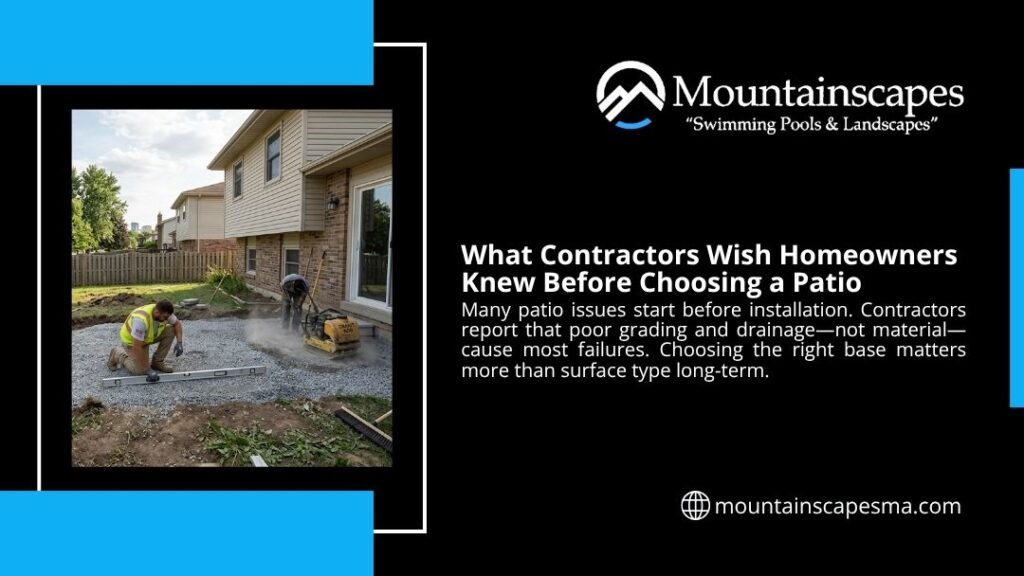
What makes stone different isn’t just the material, it’s the system beneath it. A proper base includes layers of crushed stone, compacted in stages, followed by a leveling layer where each stone is set. This allows the surface to “breathe” with the ground.
Concrete patios rely on a completely different approach. A slab is poured in place, reinforced, and left to cure into a single surface. Once it hardens, that surface behaves as one piece. There’s no give, no adjustment.
That structural difference changes how each patio handles stress. When soil shifts or temperature changes, a stone patio absorbs movement across multiple joints. A poured concrete patio resists movement, and that resistance is exactly what leads to cracking.
Homeowners often ask whether this matters in everyday use. In mild climates, maybe not right away. In regions like Massachusetts or New Hampshire, where the ground expands and contracts seasonally, it becomes a defining factor.
Cost Breakdown: Stone Patio vs Concrete Patio (Real Numbers)
Cost often drives the decision, but the numbers tell a more nuanced story.
| Patio Type | Cost per Square Foot | Installation Complexity |
| Natural stone pavers | $16–$35 | High |
| Poured concrete patio | $4–$12 | Moderate |
| Stamped concrete | $8–$19 | Moderate |
At first, concrete looks like the clear winner. However, long-term costs shift that perspective. Repairs on a concrete slab often require patching or replacement sections, which rarely match the original finish. Stone patios allow individual pieces to be replaced, which keeps repair costs manageable over time.
This is where many homeowners ask: Are pavers cheaper than concrete? The answer depends on how far ahead you’re thinking. Initial cost favors concrete, but lifetime value often leans toward stone.
What Freeze-Thaw Cycles Actually Do to Each Material
The freeze-thaw cycle is not some occasional inconvenience in the Northeast. In a typical MA/NH winter, temperatures can cross the 32°F threshold dozens of times between November and March. Each crossing is one cycle.
Each cycle pushes water into existing surface pores, freezes it, expands it, and leaves a slightly larger opening on the way out. Repeat that process sixty or seventy times across one winter, and you have a meaningful cumulative stress load on any rigid surface.
According to the analysis, in Massachusetts, the freeze-thaw cycle changes the equation. Concrete fights the ground and loses. Pavers work with the ground and last.
That’s not a sales line from a paving company. It’s the structural logic of how the materials behave. Dense natural stone, granite, quality bluestone, handles freeze-thaw well because it’s less porous and absorbs less moisture per cycle.
Concrete slabs handle it poorly because every crack that forms becomes an entry point for the next cycle’s water. Research from Q&E Keystone Masonry documents this cycle clearly: tiny cracks form, then widen, then allow deeper water penetration, then crack further. The degradation quickens over time, which is why concrete patios can look perfectly fine at year three and noticeably rough by year seven.
The base matters enormously here, too. No surface material, stone or concrete, performs well over a poorly prepared sub-base. A properly compacted crushed stone base with adequate drainage is the single most important structural decision in any patio installation.
It’s also the decision homeowners can least evaluate on their own, which is why working with contractors who understand New England soil and drainage conditions isn’t optional; it’s foundational.
Durability and Climate: Which Patio Lasts Longer?
Durability isn’t just about the material itself; it’s about how that material behaves once it’s exposed to real conditions. Soil movement, moisture, temperature swings, and even how water drains off the surface all play a role.
Concrete performs well in controlled environments, but outdoor conditions are rarely controlled. Once a concrete slab is poured, it becomes a fixed surface. If the ground beneath it shifts, even slightly, the slab has no way to adjust. That’s when cracks begin to form. In many cases, those cracks don’t show up immediately. They develop over time, often after a few seasonal cycles.
Stone patios respond differently because they’re built as a layered system rather than a single mass. The base allows for drainage and minor movement, and the individual stones can shift without breaking. This doesn’t mean they’re immune to settling, but it does mean problems tend to stay localized and manageable.
Another factor that often gets overlooked is water management. Concrete relies heavily on proper slope to move water away. If that slope is off, even slightly, water can sit on the surface or seep into weak points. Stone patios allow water to move through the joints and into the base, which reduces surface stress.
Here’s how both materials compare under real-world conditions:
| Condition | Stone Patio Response | Concrete Patio Response |
| Soil Movement | Adjusts without damage | Cracks under pressure |
| Freeze-Thaw Cycles | Absorbs expansion through joints | Expands and fractures |
| Heavy Rain | Drains through joints and base | Relies on slope; pooling possible |
| Repair Needs | Localized adjustments | Often requires visible patching |
| Long-Term Stability | Maintains structure with minor upkeep | Gradual decline over time |
In regions with changing seasons, durability is less about strength and more about flexibility. That’s where stone tends to hold its ground, literally.
Maintenance and Long-Term Costs
Both materials need maintenance. The nature of that maintenance is different, the cost is different, and, critically, what happens if you skip it is different.
For concrete patios, sealing is not optional in cold climates. You should expect to reseal every three to five years to protect the surface from moisture penetration and prevent spalling (surface flaking). Skip it, and the freeze-thaw damage accelerates.
Once surface cracking begins, you’re in repair mode, and patio repair on concrete is always imperfect. Cracks get patched, but the color never matches. The aggregate never matches. The texture never matches. Some homeowners live with it. Others eventually tear out and repour.
For stone patios, the main maintenance task is joint sanding. Polymeric sand fills the gaps between stones and stabilizes the surface. Rain, power washing, and general wear can wash some of it out over time. Plan on re-sanding joints every two to three years.
Sealing stone patios is optional; some homeowners do it for stain protection, others prefer to let the stone age naturally. If an individual stone heaves, settles, or cracks, the repair is straightforward: lift the affected unit, re-level the base layer beneath it, and either reset the stone or swap in a replacement. The surrounding surface is untouched.
| Factor | Stone Patio | Concrete Patio |
| Repairs | Replace individual stones | Patch or replace sections |
| Cleaning | Occasional wash | Frequent sealing |
| Weed Growth | Possible between joints | Rare |
| Long-Term Cost | Lower over time | Higher over time |
Concrete patios often require sealing every few years to prevent surface wear. Without it, they fade, stain, and weaken. Stone patios may need joint maintenance, but the structure itself remains intact. When evaluating maintenance costs, it becomes clear that the cheaper option upfront may not stay cheaper.
Design Versatility and Aesthetic Appeal
Design decisions usually start with what looks good, but they shouldn’t end there. The way a material fits into the overall property, how it connects to other features, and how it ages over time all matter just as much.
Stone offers a level of variation that doesn’t need to be manufactured. Each piece brings its own tone and texture, which creates a surface that feels layered rather than flat. This becomes especially noticeable in larger outdoor spaces, where repetition can make a surface feel artificial.
Concrete approaches design differently. It relies on shaping, coloring, and stamping to achieve variety. That gives homeowners control over patterns and finishes, but the result still follows a uniform structure. Over time, that uniformity can become more noticeable as wear patterns develop. The choice often comes down to whether the goal is precision or character.
| Design Element | Stone Patio | Concrete Patio |
| Visual Texture | Natural variation, irregular edges | Smooth or patterned but uniform |
| Color Range | Earth tones, subtle variation | Wide range of colors and stains |
| Pattern Flexibility | Custom layouts with unique pieces | Predefined stamped patterns |
| Integration with Landscape | Blends with surroundings | Stands out as a defined surface |
| Aging Over Time | Develops natural patina | Fades and may discolor |
Stone tends to feel like part of the property, especially when paired with planting areas, walkways, or retaining features. Concrete, while clean and consistent, often reads as a separate layer placed on top of the landscape.
For homeowners planning a cohesive outdoor space, not just a patio, the difference becomes more noticeable with time. And that’s usually when design decisions start to matter most.
Safety and Surface Performance
Neither concrete nor stone is inherently dangerous. But their surface behavior in wet and icy conditions differs in ways that show up in daily use.
Concrete surfaces, particularly when sealed, have a low friction coefficient when wet. Stamp patterns help, but they wear down. On a rainy day or a cool morning after dew, a sealed concrete patio can be genuinely slippery. Anti-slip additives can be mixed into sealers, which helps, but adds to the maintenance complexity.
Natural stone, depending on the finish, typically provides better traction. A honed or sandblasted bluestone surface has natural grip. Polished finishes, sometimes used on more formal applications, can be as slippery as sealed concrete, so finish selection matters.
For patios around pools, fire pits, or any surface where wet feet are the norm, textured stone surfaces are safer and more practical.
Heat is the other factor. Concrete retains and radiates heat aggressively in summer; a south-facing concrete patio in July can be uncomfortably hot underfoot in the afternoon. Natural stone tends to stay cooler. For families who use the patio barefoot through the summer months, that’s a comfort issue that compounds over time.
Installation Process: What to Expect
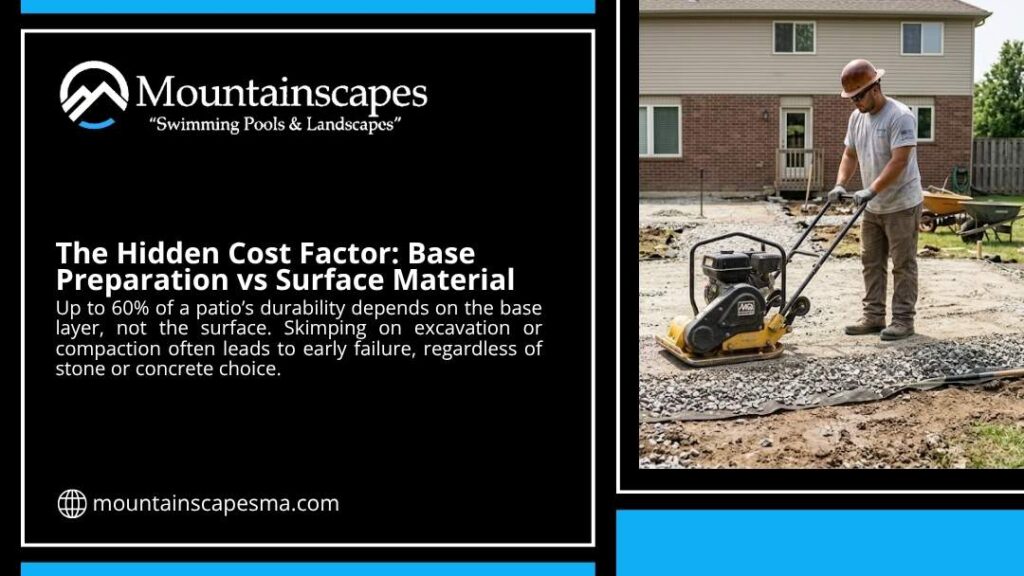
Installation is where quality either holds up or falls apart. The material matters, but the process matters just as much. Below is a simplified breakdown of how each patio type is installed:
| Step | Stone Patio Installation | Concrete Patio Installation |
| Site Prep | Excavation and grading | Excavation and grading |
| Base Layer | Crushed stone compacted in layers | Gravel base or compacted soil |
| Leveling | Sand or stone dust layer | Formwork setup |
| Placement | Individual pavers laid by hand | Concrete poured into forms |
| Finishing | Joint filling and compaction | Smoothing, stamping, curing |
| Cure Time | Immediate usability after setting | Several days to fully cure |
Pouring concrete requires site preparation, framing, pouring, and curing. The process is quicker but leaves little room for correction once complete.
Stone patios involve base preparation, leveling, and careful placement of each piece. The process takes longer, but it allows for precision.
For homeowners considering professional work, working with experienced landscape construction services ensures proper grading, drainage, and structural stability.
Stone Patio vs Concrete Patio for Pools and Backyard Spaces
When water enters the picture, the choice becomes more practical than aesthetic. Pool decks and backyard patios deal with constant moisture, foot traffic, and temperature swings.
| Factor | Stone Patio Around Pool | Concrete Patio Around Pool |
| Slip Resistance | Naturally textured, better grip | Can become slippery |
| Heat Retention | Stays cooler | Retains heat |
| Drainage | Allows water movement between joints | Requires a precise slope |
| Repair | Easy to replace sections | Repairs are visible |
| Longevity | Handles seasonal movement well | Prone to cracking |
For poolside environments, these differences matter daily. Comfort underfoot, safety when wet, and long-term durability all come into play.
This is why many custom outdoor builds lean toward pavers in pool areas. They provide a balance of function and appearance that holds up under constant use.
Stone Patio vs Deck vs Concrete Patio: What’s the Difference?
Each option serves a different purpose depending on the property and layout.
| Feature | Stone Patio | Concrete Patio | Deck |
| Elevation | Ground level | Ground level | Raised or elevated |
| Material | Natural stone pavers | Poured concrete | Wood or composite |
| Maintenance | Moderate | Moderate to high | High |
| Lifespan | Long-term | Moderate | Varies |
| Best Use | Integrated outdoor spaces | Budget-friendly patios | Uneven terrain |
A deck makes sense when elevation is required. Patios, whether stone or concrete, work best when the space connects directly to the ground.
When homeowners compare patio vs deck options, the decision often comes down to terrain and maintenance preferences. Stone patios tend to offer a middle ground: durable, low-maintenance, and visually integrated into the landscape.
When Stone Makes More Sense (Real Scenarios)
Stone becomes the better choice in situations where the outdoor space is meant to last, not just function. It fits properties where the patio connects to other elements, walkways, retaining walls, and planting areas. The material blends into the landscape rather than sitting on top of it.
It also works well in areas with uneven ground. Instead of forcing the terrain into a rigid shape, stone adapts to it. That reduces stress on the structure over time.
Homeowners planning long-term often lean toward stone because it holds its appearance. It doesn’t just survive, it ages in a way that feels intentional.
When Concrete Is the Better Choice
Concrete still has a place. It works when the goal is straightforward: create a clean, usable surface without stretching the budget. It suits smaller patios, secondary outdoor areas, or projects where speed matters. Installation can move quickly, and the result is predictable.
For homeowners who plan to upgrade later, concrete can act as a temporary solution. It delivers immediate function without a large upfront investment. That said, expectations should stay realistic. Concrete performs best when conditions are controlled, such as stable soil, proper drainage, and limited exposure to extreme temperature changes.
Common Mistakes Homeowners Make When Choosing a Patio
Regardless of which material gets selected, certain installation and planning mistakes produce poor outcomes on either surface. They’re worth understanding before any decision gets made.
Skipping the drainage conversation: A poorly drained yard will degrade any patio faster than the harshest winter. Water pooling at the edge of a slab accelerates concrete cracking. Water beneath a paver base causes heaving and settlement. Before choosing a material, understand where the water goes when it rains hard. If the answer isn’t clear, it needs to be.
Choosing material before grading: The slope of the finished surface, the relationship between patio elevation and the house foundation, and how the patio edge connects to the surrounding landscape are decided in the grading phase, not the material phase. Getting the grade right is more important than any surface choice.
Focusing on day-one appearance: Both materials look fine right after installation. The honest question is what they look like in year six, after four New England winters and the maintenance cycle that comes with them. Ask contractors specifically what to expect in a cold climate. The answer should inform the decision.
Treating it as a separate project: The best patio installations happen when the patio is planned alongside the pool, the planting, the outdoor kitchen, or whatever else is happening in the outdoor space. When things are designed together, drainage works, materials coordinate, and the grading makes sense for all of it simultaneously. Retrofit one element onto a completed yard, and you’re usually making compromises.
Which Option Holds Up Better Over Time?
Time changes everything. What looks similar in the first year rarely performs the same after ten. Stone patios tend to maintain their structure. Minor adjustments, releveling, or replacing individual pieces keep the surface functional without major disruption.
Concrete patios often show wear in stages. Small cracks appear first, followed by surface fading and eventual structural issues. Repairs can extend lifespan, but they rarely restore the original look.
Long-term value isn’t just about durability. It also includes how the space looks and feels after years of use. Stone tends to retain its character. Concrete often requires more effort to keep it looking presentable. That difference becomes more noticeable with each passing season.
FAQs about Stone Patio vs Concrete Patio
Which is cheaper long-term, a stone patio or a concrete patio?
Concrete usually costs less upfront, but stone often ends up cheaper over time due to lower repair and maintenance needs.
Does concrete crack in cold climates like Massachusetts?
Yes, freeze-thaw cycles create internal pressure that leads to cracking over time, especially if the base preparation isn’t perfect.
How long does a stone patio last versus a concrete patio?
A well-built stone patio can last 30–50 years or more. Concrete patios typically last 20–30 years, depending on conditions.
Can you repair a stone patio without it looking patched?
Yes. Individual stones can be replaced without affecting the surrounding area, which keeps repairs less noticeable.
Is stone or concrete better around a pool?
Stone generally performs better due to traction, cooler surface temperature, and resistance to cracking.
What’s the difference between pavers and natural stone?
Pavers can be manufactured or natural. Natural stone comes directly from quarried rock, while concrete pavers are molded.
Are pavers stronger than concrete slabs?
Individually, slabs may seem stronger, but as a system, pavers handle stress better because they distribute movement.
Is it cheaper to lay concrete or pavers?
Concrete is cheaper initially. Pavers cost more upfront but may reduce long-term expenses.
Ready to Build the Right Outdoor Space?
Choosing between stone and concrete is only one part of the process. The real outcome depends on design, drainage, and how everything comes together on your property.
If you’re planning a patio, pool, or full outdoor upgrade, it helps to work with a team that handles the entire process, from concept to construction. You can take the next step and connect with a local design-build team. A well-built outdoor space doesn’t just look good; it works better every year after it’s finished.
The right decision now saves time, money, and effort later, and that’s what truly defines a successful outdoor space.