

A well-lit backyard should feel like an extension of your home, inviting, comfortable, and easy to be in after dark. This guide explains how to light a backyard without it looking overdone by focusing on placement logic, the three-layer framework professionals actually use, color temperature, and the specific mistakes that make even expensive setups look cluttered. It covers what works, what goes wrong most often, and how to put it together so the yard feels natural at night rather than floodlit.
How to Light a Backyard Without It Looking Overdone
A backyard doesn’t look overdone because it’s missing lights. It looks overdone because it has too many, placed without much thought, every corner glowing at the same intensity. Spotlights pointed at things that don’t need spotlights. String lights were wrapped around every available surface just because there was a leftover strand. The result stops feeling like an outdoor retreat and starts looking like a strip mall.
What makes the difference, and this is genuinely the core of it, isn’t the brand of fixture or how much was spent. It’s about whether someone thought about why each light belongs where it is before deciding what to buy. That’s it. The rest follows from there.
Knowing how to light a backyard without it looking overdone really comes down to atmosphere over coverage. Not every corner needs light. Some of the best outdoor spaces at night are defined as much by where the light isn’t as by where it is.
Shadows are part of the design. They add contrast and depth. A yard that’s fully illuminated from edge to edge reads flat, visually; there’s nowhere for the eye to rest or for any feature to stand out against anything else.
Strong data is reinforcing why this matters. The 2023 Remodeling Impact Report from the National Association of Realtors (NAR) and the National Association of Landscape Professionals (NALP) found that landscape lighting earned a perfect Joy Score of 10 out of 10 among homeowners who completed the project, the joint-highest rating in the entire study, alongside in-ground pool installation. The average cost lands around $6,800 for a professional setup. That’s a significant satisfaction return for an investment you’re looking at every single night. Even so, a poorly planned lighting scheme drags down the look of even a well-built outdoor space. So here’s what actually works.
Why Most Backyard Lighting Ends Up Looking Too Bright
A backyard rarely gets overdone on purpose. It happens gradually, one impulse purchase at a time. Someone picks up a pack of solar stake lights, another set goes in along the fence, string lights go up across the patio, and then a couple of spotlights appear because the corner felt too dark. Before long, forty light sources are competing with each other, and none of them is doing their job particularly well.
The core issue isn’t the fixtures themselves; it’s that they were chosen without a plan for how they’d interact with each other or with the yard.
The Floodlight Effect Problem
Floodlights promise visibility, and they do deliver it; the problem is that they deliver it everywhere at once. Shadows disappear, textures flatten, and the space ends up looking exposed rather than comfortable. There’s no depth. A yard lit primarily by floods feels like it’s being held for questioning, not enjoyed.
Too Many Fixtures, Not Enough Planning
Stacking multiple outdoor lights for backyard areas doesn’t add sophistication. It adds noise. When everything competes for attention at the same level of brightness, nothing actually stands out, and the yard looks busy instead of designed.
Ignoring Natural Shadows
This is the one most homeowners miss entirely. Good outdoor lighting doesn’t try to eliminate shadows. It uses them. Contrast, light against dark, is what creates depth and dimension in a landscape — the same influence of lighting on visual performance that governs how the eye reads a scene. Without it, even high-quality backyard outdoor lighting ideas land flat. Darkness is part of the palette. Treat it that way.
The 3-Layer Lighting Rule That Changes Everything
Professional outdoor lighting designers don’t think about fixtures. They think about layers. That’s the fundamental shift, and it explains why one yard with modest fixtures looks considered while another with twice the hardware looks like a mess.
The three-layer system consists of ambient lighting, task lighting, and accent lighting. Each one does a specific job. Each one also makes the other two perform better by existing alongside them.
Ambient Lighting
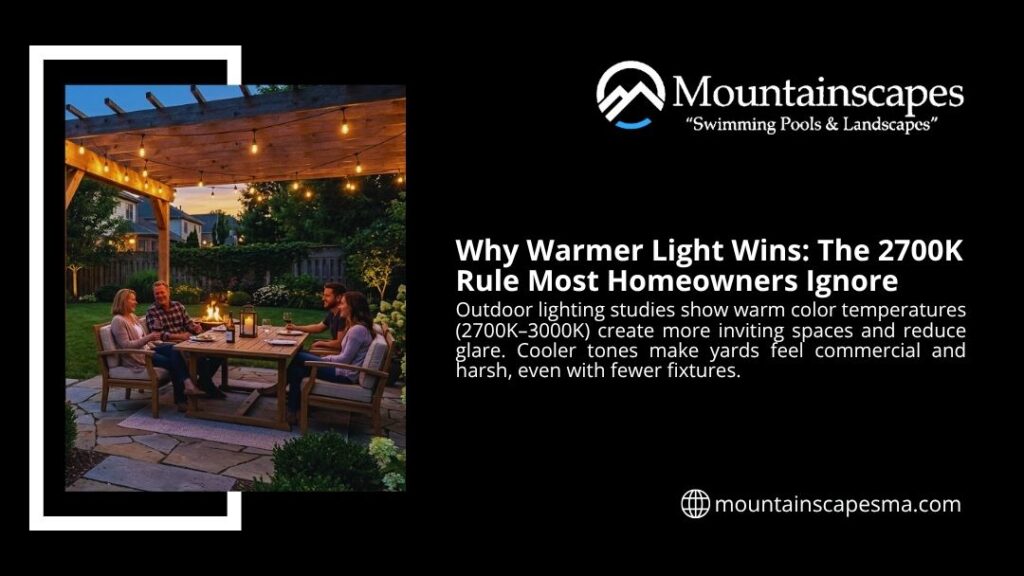
This is the base layer. It creates the overall mood, a soft, diffuse glow that makes a space feel occupied and welcoming rather than empty and dark. This comes from wall-mounted sconces near a back door, low-wattage pendants fitted into a pergola, or even a fire pit casting warm light across nearby seating. Ambient light doesn’t need to be bright. It needs to be consistent, so the yard feels like one unified space rather than a collection of lit islands.
Task Lighting
This layer serves a purpose. This is where function lives. The steps off the deck. The path between the back door and the garage. The surface of an outdoor kitchen. Step lights, low-voltage yard lights, and under-cabinet strips all belong here. They’re practical first. But practical doesn’t mean unattractive; a well-chosen low-profile path light along a stone walkway can be genuinely good-looking while still doing exactly what it’s meant to do.
Accent Lighting
This is where character enters. An uplight at the base of a specimen tree. A recessed fixture grazing a stone retaining wall. A spotlight on the edge of a water feature. Used carefully, it makes a yard feel intentional. Used too liberally, everything starts competing for the same amount of attention, which ironically means nothing stands out at all.
| Layer | Primary Job | Typical Fixtures | Where It Belongs |
| Ambient | Background mood and warmth | Wall sconces, pendant lights, fire pit, string lights | Spread across occupied zones |
| Task | Safety and function | Path lights, step lights, low voltage yard lights | Grade changes, entries, and outdoor cooking areas |
| Accent | Draw attention to key features | Uplights, spotlights, recessed deck fixtures | Trees, walls, water features, structures |
Here’s the part that surprises people: a yard lit purely with accent lights feels theatrical and cold. One with only task lighting feels like a job site. Only ambient? Flat, like someone flipped a switch and went back inside without thinking about it. All three working together is what takes a backyard from lit to actually designed.
Once you understand this structure, it becomes easier to see how to light a backyard without it looking overdone. You stop adding lights and start shaping the space.
Best Backyard Lighting Ideas That Feel Subtle, Not Harsh
Not every outdoor lighting approach produces the same result. Some ideas work with the existing landscape. Others dominate it. The difference usually comes down to whether the light source stays hidden or not.
Hidden landscape lighting, LED strips tucked under deck steps, uplights buried at the base of a shrub, recessed fixtures flush with a patio surface, build depth and visual interest without asking you to notice the hardware. The light does the work. The fixture stays out of the conversation. That’s the standard worth aiming for across every zone of the yard.
For seating areas specifically, backyard patio lighting should feel relaxed. Pendant lights or indirect sconces work better than bare exposed bulbs. Edison-style filament bulbs draw attention for the right reasons; the visible filament reads as warm and intentional. A bare PAR bulb in an open socket just looks like someone needed more light and grabbed the nearest option.
Ginger Wilcox, former president of Better Homes and Gardens Real Estate, put it plainly in a piece published by the National Association of Realtors: “Lighting is one of the easiest ways to completely change the feel of a space, without breaking the bank.” The implication isn’t just financial. It’s that the change comes from intention, not quantity.
A compact yard doesn’t need fewer lights in absolute terms; it needs more restraint in placement. One or two strong focal points, a consistent ambient layer, and careful pathway coverage are more than enough. Adding fixtures to fill every available space in a small yard is what makes it feel like a storage unit after dark.
Where to Place Outdoor Lights for a Natural Look
Placement does more work than the fixture itself. A mediocre fixture in the right location outperforms a premium one pointed in the wrong direction, every single time.
Pathway lighting ideas that actually work tend to break symmetry rather than follow it. The instinct is to line up path lights at even intervals on both sides of a walkway, and the result looks like a runway.
Staggering the fixtures, alternating sides, varying the spacing slightly, these small adjustments make the path feel natural rather than marked for a landing. According to the industrial guide, it specifically calls out overly symmetrical placement as something that makes residential paths feel stiff and commercial. Avoid it.
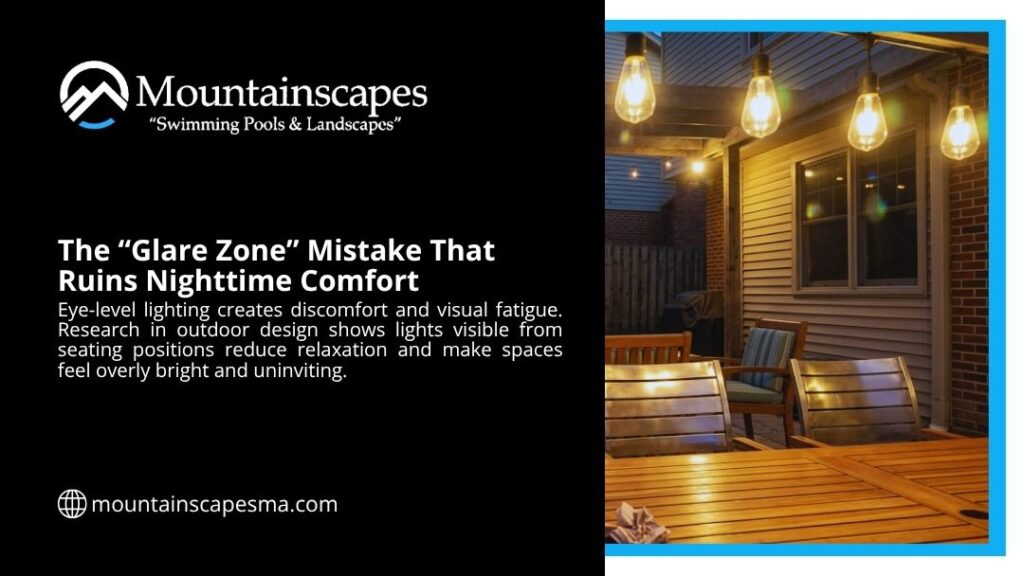
Around seating areas, lighting should sit above or slightly behind eye level. Fixtures at eye level from a seated position produce glare, the kind that makes you squint when you’re trying to relax. The bulb itself shouldn’t be visible from the seat. The light it casts should be.
For trees and garden features, backyard spotlight ideas work best when they’re minimal. One well-aimed uplight on a feature worth noticing does more than three spread across mediocre plantings. The rule is simple: only light what you’d point at in daylight and say, “That’s one of my favorite things out here.” If that test doesn’t apply, the spotlight probably doesn’t either.
Fixtures need to be hidden wherever possible. A well-designed outdoor lighting setup is one where you notice the effect, the glow on the wall, the shadow cast through the branch structure, without noticing the hardware producing it. Conceal the source. Let the result speak.
Brightness Matters More Than Quantity
Lighting design often fails because people focus on how many fixtures they need rather than how bright each one should be.
| Area | Recommended Brightness | Effect |
| Pathways | Low (40–80 lumens per fixture) | Subtle guidance without glare |
| Patio | Medium (100–200 lumens) | Functional yet comfortable |
| Garden Features | Low (40–100 lumens) | Adds depth and contrast |
| Pool Area | Medium (150–250 lumens) | Safe visibility, soft ambiance |
| Tree Canopy Uplighting | Medium (150–300 lumens) | Drama without washing out the surrounding area |
A lower brightness level almost always creates a more refined result. This is one of the simplest ways to control lighting for backyard spaces without going overboard.
Choosing the Best Backyard Lighting System
The type of system matters beyond aesthetics. It affects how reliably the setup performs, how much it costs to run, and how well it holds up to the climate, freeze-thaw cycles, heavy wet springs, and winters that are hard on anything plastic left in the ground.
| System Type | Best Use | Pros | Cons |
| Low Voltage (12V) | Pathways, accent, general coverage | Precise control, energy-efficient, safe to work with, easy to reconfigure | Requires transformer installation |
| LED Fixtures | All outdoor zones | Long lifespan, wide color temperature range, very low energy use | Higher upfront cost per fixture |
| Solar | Supplemental accent, open sun-exposed areas | No wiring required, zero operating cost | Unreliable in shaded or north-facing yards |
| Battery Powered | Temporary setups, decorative use | Flexible placement, no wiring | Requires frequent battery changes |
For most homeowners, low-voltage systems offer the best balance. They provide control without overwhelming the space, making them ideal for anyone learning how to light up a backyard properly.
Backyard Lighting Mistakes That Ruin the Look
A backyard rarely ends up looking overdone by accident. Certain patterns lead there almost every time. Most are avoidable once you know what to look for.
Treating every zone the same. A pathway, a seating area, and a specimen tree all need different light levels and different fixture types. Sticking the same solar stake light across all three zones, because it’s what the multipack came with, is how a yard ends up looking like no one thought about it.
Mixing color temperatures. One warm-white zone next to a daylight-range zone next to a neutral creates visual incoherence that’s difficult to describe but immediately obvious when you see it. Pick a color temperature range and stay in it across the whole yard.
String lights are applied indiscriminately. String lights are genuinely effective when they define a specific zone, hung above a dining area or between two posts over a seating nook, they form a soft overhead canopy that makes the space feel contained and intentional.
Draped loosely across every fence, wrapped around every tree, strung at three different heights for no particular reason, that’s when they stop being a design element and start being clutter with a power cord.
Ignoring the overall landscape design. Lighting doesn’t exist in a vacuum. A stone patio with warm-toned pavers reflects natural light from warm LED bulbs. The same patio lit with cool, bluish-white fixtures reads disconnected and cold.
Fixtures and color temperatures should respond to the materials they’re illuminating, not just be placed wherever they seem convenient. This is part of why lighting works better when it’s planned alongside the landscape rather than fitted in afterward.
Forgetting that the fixture itself has to disappear in daylight. A good outdoor lighting setup looks nearly invisible during the day. The hardware should be small, dark, or tucked behind plant material wherever possible. If the fixtures are prominent features of the yard in daylight, large, silver, standing at chest height, the lighting is already competing with the landscape before dark even arrives.
DIY Backyard Lighting Ideas That Actually Work
Not every lighting project requires a full redesign. Some of the best diy backyard lighting ideas focus on simplicity.
Hidden LED strips under deck or stair risers produce soft, clean step lighting that’s nearly invisible during the day and genuinely functional after dark. The effect is more refined than visible path lights, and the installation is straightforward for anyone comfortable with basic electrical work at low voltage.
Mason jar lights and lantern-style fixtures work well for smaller seating areas when the goal is decorative warmth rather than functional coverage. They’re not a replacement for a real ambient layer, but as supplemental accent lighting, they can look genuinely good.
The DIY mistake isn’t choosing to do the work yourself. It’s treating quantity as a substitute for thought. Cheap diy outdoor lighting ideas can look polished when brightness is controlled and placement is deliberate. The same fixtures scattered across the yard at random look exactly like what they are: a bag of lights from a hardware store, distributed without a plan.
For anything involving actual trenching, transformer sizing, or integration with a pool or outdoor kitchen structure, the DIY path tends to produce compromises that wouldn’t have been necessary with professional installation. The complexity of the yard, not the desire to DIY, should determine which approach makes sense.
Small Backyard? Here’s How to Light It Without Overcrowding
Compact yards are the ones most prone to getting overdone, precisely because they’re compact. Every fixture has more visual impact in a small space, and adding one too many tips the whole thing over into cluttered territory.
The principle that works in small spaces is reflection over addition. A single light source aimed at a pale wall or a light-colored patio surface can illuminate the surrounding area more naturally than three direct fixtures pointed at the center of the yard.
The reflected light is softer, more diffuse, and harder to identify as coming from a specific source, which is exactly the quality that makes a yard feel atmospheric rather than lit.
One focal point, a specimen tree, a fire pit, and a water feature can anchor the design. Everything else supports it without competing. In a small courtyard setting, that kind of visual hierarchy is what makes the space feel deliberate rather than decorated.
When in doubt in a small yard, take one light out. The remaining setup almost always looks better. This is not a compromise; it’s a design principle.
How Professional Landscape Design Makes Lighting Look Better
Lighting doesn’t exist in isolation. It works best when integrated into the overall layout of the yard. Well-planned custom outdoor spaces often include lighting from the beginning, not as an afterthought. When pools, patios, and planting areas are designed together, the lighting feels seamless rather than forced.
Projects that combine structure and lighting, like those seen in real backyard transformations, show how balance creates a more natural result. This approach also supports long-term improvements, especially when paired with thoughtful planning from a learning-focused resource hub that explains design choices clearly.
When to Upgrade Your Backyard Lighting Setup
Sometimes the individual fixtures aren’t the problem. Sometimes the whole system needs a rethink. Signs it’s time: lights that feel uneven across zones, zones that are bright enough to see but not comfortable to be in, fixtures that have aged or drifted out of position over winter, or a setup that was installed as an afterthought alongside a pool or patio build and was never really planned for the space.
In some cases, lighting problems point to deeper issues in the layout, a patio edge that doesn’t have enough definition to anchor a fixture, a planting bed that’s too dense for any uplight to penetrate usefully, or a deck structure that wasn’t built with conduit runs in mind.
Understanding signs your backyard needs a drainage system can also be part of the same conversation: a yard that holds water poorly tends to degrade outdoor fixtures faster than it should, which becomes a maintenance problem on top of a design one.
A full outdoor renovation, new pool, rebuilt patio, updated landscape, is the most practical context for also resetting the lighting. All the infrastructure decisions happen while the ground is already open. The lighting doesn’t get added on top of finished work. It gets built in from the start.
The Smart Way to Light Up Your Backyard Without Overdoing It
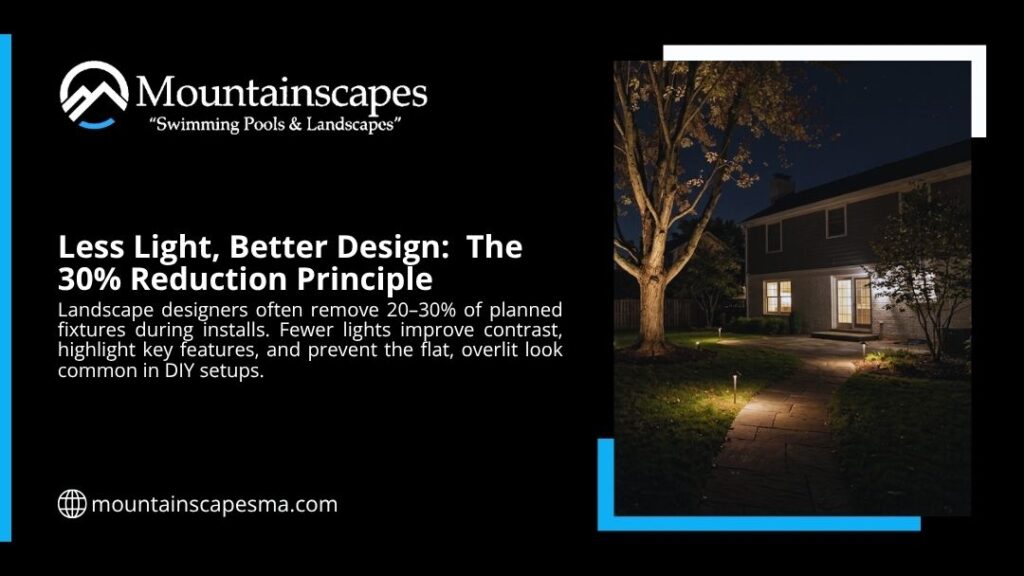
So here’s what it comes down to. Fewer lights, better placement, and controlled brightness will always outperform a cluttered setup. Learning how to light a backyard without it looking overdone isn’t complicated, but it does require intention. Start with layers, focus on subtlety, and let the space guide your decisions.
If you’re planning a full outdoor upgrade or want a layout that actually works at night, it may help to speak with a team that understands both design and execution. You can visit Mountainscapes to explore what’s possible for your space.