

Yes, but it’s not as straightforward as most homeowners hope. Whether a pool adds value to your home depends heavily on where you live, the type of pool you install, the age of the pool, and how well it’s been maintained. For Massachusetts and New Hampshire homeowners, the calculus is different from that in Florida or Arizona.
This guide breaks down the real numbers, the hidden costs, what appraisers actually look for, and the factors that give a pool its best shot at paying off.
Does a Pool Increase Your Home Value?
Most real estate experts agree that the answer is yes, with a very important caveat. According to data, a swimming pool can boost a home’s value by up to 7% on average. At the National Association of Realtors’ June 2025 median existing-home price of $435,300, even an estimated 7% boost would amount to about $30,471 in added value, though actual returns vary widely by market and pool design.
But here’s the thing, the average cost to install an inground pool runs between $50,000 and $100,000 or more. So on paper, you’re often looking at a negative return before you’ve even opened the pool for your first swim season.
That doesn’t mean adding a pool is a bad decision. It means it’s rarely a purely financial one. For homeowners who plan to stay in their home for years and genuinely want to use that space, the lifestyle value can be considerable. But for anyone considering adding a pool strictly to increase what buyers will put a price on, the math rarely lands where they expect.
Here’s what the data shows at a glance:
| Key Metric | National Average |
| Average home value increases from a pool | 5% to 7% |
| Average inground pool installation cost | $50,000 – $100,000+ |
| Typical ROI (return on cost) | 40% to 60% |
| Pre-pandemic pool value premium | $16,137 |
| Post-pandemic pool value premium | $27,199 |
| NAR 2023 Remodeling Impact Report ROI | 56% average for inground pools |
The National Association of REALTORS®’ 2023 Remodeling Impact Report: Outdoor Features estimates that a typical in-ground pool addition costs about $90,000 and recovers about $50,000 at resale, which works out to roughly 56% of project cost. It’s not a dollar-for-dollar return, but it’s nothing either.
In-Ground vs. Above-Ground: A Critical Difference
When homeowners start comparing options, the difference between in-ground and above-ground pools often becomes the deciding factor, especially when long-term value is part of the conversation. Not all pools are viewed the same way by buyers or appraisers, and that distinction can shape how your investment performs over time.
Inground pools, whether gunite, fiberglass, or vinyl liner, are treated as permanent fixtures attached to the land. On the other hand, above-ground pools are typically classified as personal property.
| Pool Type | Classification | Appraisal Impact | Buyer Perception | Long-Term Value Potential |
| Gunite (Inground) | Permanent structure | High | Premium, custom-built | Strong |
| Fiberglass | Permanent structure | Moderate to High | Clean, modern | Good |
| Vinyl Liner | Permanent structure | Moderate | Practical, budget-friendly | Moderate (depends on upkeep) |
| Above-Ground | Personal property | Low to none | Temporary, sometimes unwanted | Minimal |
In simple terms, the more permanent and integrated the pool feels, the more likely it is to contribute to property value. That’s why homeowners who think long-term often lean toward in-ground options that align with the overall design of their outdoor space.
What Does a Pool Actually Do to an Appraisal?
Here’s where things get eye-opening for most homeowners. Appraisers do not credit a pool at its replacement cost. A $90,000 gunite pool will not add $90,000 to your appraised value. Not even close.
The appraisal process is rooted in comparable sales, what similar homes with pools have actually sold for in that area. If there aren’t many comps with pools nearby, the appraiser has limited data to justify a large bump.
That gap, between what you spent and what an appraiser credits, is what most homeowners don’t anticipate. It doesn’t mean the pool has no value. It means appraisals are a conservative, market-anchored measure, not a reflection of personal investment.
The age of the pool also plays a role. A 10-year-old pool with aging equipment, a worn liner, or outdated coping and decking will receive far less credit than a new or recently renovated installation. This is one reason why pool renovations, updating the pool shell, replacing equipment, and refreshing the surrounding hardscape can sometimes offer better financial return per dollar spent than building from scratch.
How Location Shapes the Return
Climate and neighborhood norms aren’t just background factors; they’re arguably the most important variables in whether a pool increases home value in any meaningful way.
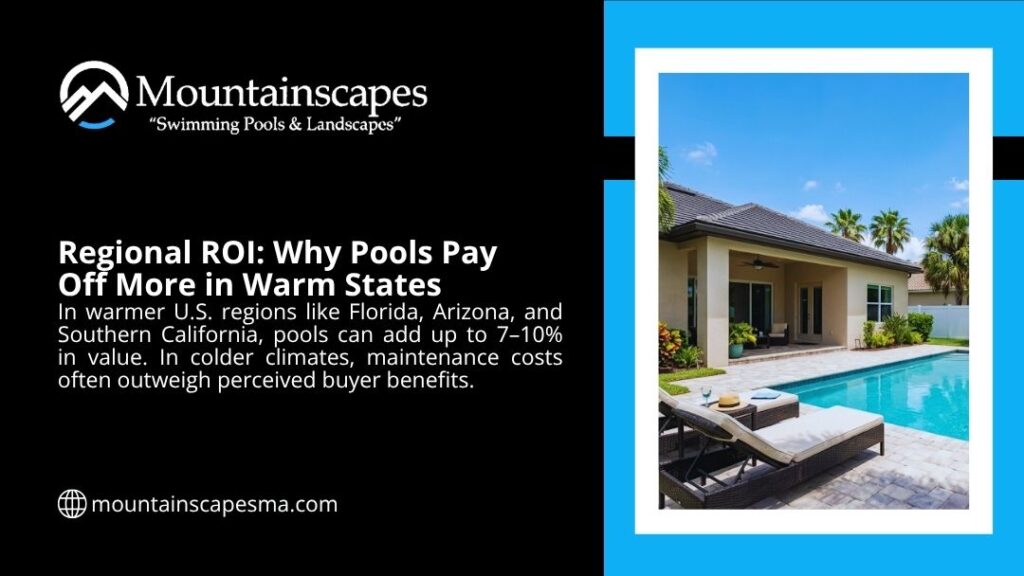
In warm-weather states like Florida, California, Texas, and Arizona, pools are expected. Buyers in those markets often pass on homes without them. That demand creates real competitive value. In cooler, northern climates, the swim season is shorter, pool ownership carries more seasonal maintenance costs, and a smaller share of buyers actively want one.
Massachusetts and New Hampshire fall into this second category. That’s not to say pools don’t add any value here; they absolutely can, particularly in neighborhoods where they’re more common, in higher-end properties, and when they’re part of a well-designed outdoor living space rather than a standalone installation. But the premium tends to be more modest than in Sun Belt markets.
According to the breakdown by region, pools can actually decrease home values in places like Massachusetts for certain buyer segments. This is because some buyers see a pool, especially an older or isolated one, as a cost burden rather than an asset. The maintenance, the insurance implications, the safety fencing, the seasonal opening and closing costs, for buyers who aren’t pool people, those line items can shrink the number of people willing to make an offer.
This is precisely why the design of the outdoor space matters so much. A pool that’s integrated into a cohesive landscape, surrounded by tasteful hardscape, privacy plantings, good lighting, and functional outdoor living areas, reads as an asset. A pool dropped into a yard with nothing else around it reads as an obligation.
Regional Pool Value Premiums (Select Markets):
| City / Market | Estimated Pool Value Premium |
| Los Angeles, CA | ~$95,393 |
| Fort Myers, FL | ~20.4% of home value |
| Pittsburgh, PA | ~11.5% of home value |
| Phoenix, AZ | ~$11,591 |
| New England markets (MA/NH) | Moderate; highly context-dependent |
| National average | 5% – 7% of home value |

The True Cost of Pool Ownership
Owning a pool involves more than the upfront investment. Many homeowners focus on installation, but the long-term expenses often shape the real cost of ownership. When evaluating whether adding a pool makes financial sense, it helps to look at the full picture rather than just the initial build.
| Cost Category | Estimated Range (10-Year Period) | What It Covers |
| Initial Installation | $65,000 – $100,000+ | Construction, materials, and site preparation |
| Annual Maintenance | $12,000 – $18,000 | Cleaning, chemicals, seasonal service |
| Equipment Replacement | $8,000 – $15,000 | Pump, heater, and filtration system upgrades |
| Surface & Structural Repairs | $10,000 – $20,000 | Replastering, liner replacement, coping repairs |
| Total Estimated Ownership | $95,000 – $150,000+ | Combined long-term cost of ownership |
Looking at costs this way gives a more realistic sense of what to expect over time. Planning ahead for maintenance and upgrades helps avoid surprises and ensures the pool continues to function as intended while protecting the overall outdoor space.
Homeowners Insurance With a Pool: What to Expect
This piece of the puzzle surprises many homeowners. Adding a pool means adding a liability, and your insurance company will want to account for that.
The increase in your homeowners’ insurance with a pool isn’t enormous for most policies, but it’s real. In-ground pool installations typically raise premiums by about $50 to $75 per year at the base level, though the full picture is more nuanced. The bigger consideration is liability coverage.
Standard homeowners’ policies carry $100,000 in liability protection. Most insurance professionals recommend raising that limit to $500,000 when a pool is present, particularly because drowning is the leading cause of unintentional death among children ages 1 to 4, as reported by the CDC.
A swimming pool increases your home insurance premium due to the higher risk of accidents and injuries. The increase depends on pool type, fencing, safety features, your claims history, and how the pool is classified, either as part of your dwelling or as a separate structure.
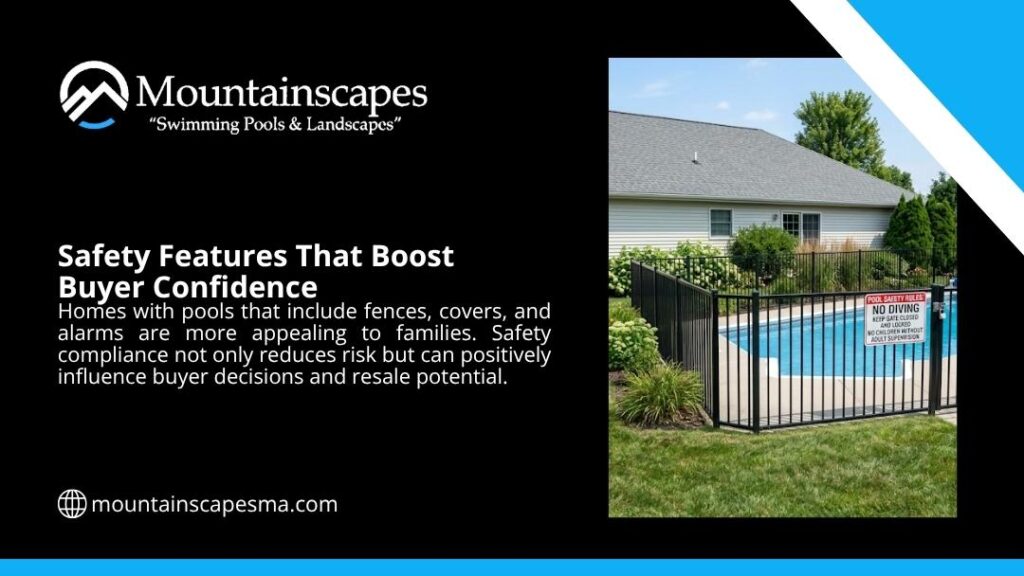
Some insurers are also reluctant to provide coverage on pools that lack proper fencing. Many states, including Massachusetts, have specific pool barrier requirements in their building codes. Getting the fencing and safety features right isn’t just good practice; it can directly affect your insurability and your premium. Certain features, like diving boards, may result in liability exclusions with some carriers.
Here’s a general breakdown of insurance considerations to keep in mind:
| Insurance Factor | What to Know |
| Base premium increase (inground) | ~$50 – $75/year at minimum |
| Recommended liability coverage | Increase to $500,000 |
| High-risk features (diving boards, slides) | May trigger exclusions |
| Safety fencing | Often required for coverage; required by the MA building code |
| Pool type classification | Affects whether it falls under dwelling or other structures coverage |
When Does Adding a Pool Make Financial Sense?
Given everything above, there are circumstances where adding a pool does make solid financial sense, and a few where it almost certainly doesn’t.
It makes more sense when you plan to stay in the home long-term. The lifestyle value of using the pool for 10 or 15 years is real and meaningful, and it gives the property time to appreciate with the pool as a feature. It also makes more sense when the surrounding outdoor space is designed holistically, not just a pool in a yard, but a true outdoor living environment with hardscape, landscaping, lighting, and comfortable gathering areas.
Homes with a well-integrated outdoor space are simply easier to sell and command better prices from the right buyers. You can see what that type of design looks like in the Mountainscapes project gallery.
It makes less financial sense when the primary goal is short-term resale value, when the yard is small or awkward for a pool layout, or when the neighborhood doesn’t have many other pool properties. In those cases, the investment is much harder to recover, and the pool may actually narrow your buyer pool at sale time.
There’s also the matter of what else the money could do. The National Association of Realtors consistently points out that kitchen and bath renovations, landscaping upgrades, and certain structural improvements often deliver higher ROI per dollar than pool installations.
If you’re working within a budget and value appreciation matters most, those alternatives deserve serious consideration alongside the pool question.
For families who love outdoor living and will use the space consistently, the experiential return often outweighs the financial calculus entirely.
The Outdoor Living Context: Why Design Matters
One thing that separates pool projects that hold their value from those that don’t isn’t just the pool itself; it’s everything around it. The most financially resilient pool installations are those where the pool functions as the centerpiece of a complete outdoor living environment.
Thoughtfully designed decking, privacy landscaping, comfortable seating areas, lighting, and outdoor kitchen setups transform a pool from a single-purpose amenity into a full extension of the home’s living space.
Buyers, even those who weren’t specifically looking for a pool home, respond differently when the outdoor area genuinely feels livable and intentional. That integrated approach is also what tends to perform better in appraisals, since the comps in premium neighborhoods increasingly feature full outdoor living spaces rather than standalone pools.
This is the philosophy behind how Mountainscapes designs and builds outdoor spaces, starting with the full picture rather than a single feature. From excavation and grading to masonry, hardscaping, planting, lighting, and irrigation, everything works together toward a cohesive outdoor environment.
It’s also why the permitting and design phase matters as much as the construction itself, because a poorly sited pool surrounded by generic hardscape will never perform the same way at resale as one that was thoughtfully planned from the ground up.
Common Mistakes That Hurt Pool Value
When homeowners think about value, they often focus on what to add. Just as important, though, is what to avoid. Certain missteps can quietly reduce the impact a pool has on resale, even if the build itself was done correctly.
| Mistake | What Happens | Impact on Home Value |
| Poor maintenance | Visible wear, like stains, cloudy water, or outdated equipment, raises concern | Negative |
| Oversized pool for the yard | Limited space for lawn, seating, or landscaping reduces usability | Negative |
| Ignoring proper drainage | Water issues, settling, and erosion create long-term structural concerns | high negative |
Each of these issues tends to shape how buyers interpret the entire property, not just the pool. When the space feels balanced, well-kept, and thoughtfully planned, it supports value rather than working against it.
Making the Decision That’s Right for You
So, does a pool increase your home value? In most cases, yes, but rarely dollar for dollar, and the outcome varies more by location, design, and condition than most homeowners expect. For Massachusetts and New Hampshire homeowners, the value lift tends to be more moderate than in warm-climate markets, which makes the design quality and integration of the outdoor space that much more important.
Here’s a practical frame for thinking about it: if you’d use and enjoy the pool for at least seven to ten years and you’re committed to maintaining it well, the lifetime value, in both experience and resale contribution, is much easier to justify. If you’re adding a pool primarily to put a price tag on it before selling in two or three years, the numbers rarely work out.
For homeowners who want a realistic look at what a project would involve, from site assessment through permits to final construction, Mountainscapes offers consultations that cover the full scope, with no obligation and no surprises about scope or cost.
With over a decade of experience handling every phase of pool and landscape projects in Massachusetts and New Hampshire, the team understands both what makes a great outdoor space and what holds its value over time.
The question isn’t just whether a pool adds value. The better question is whether the right pool, designed and built the right way, adds value worth having, now and when it matters most.
Ready to explore what’s possible for your property? Contact Mountainscapes to schedule a consultation and find out what a custom design-build project would look like for your home.