

Sometimes yes, sometimes no, and the wrong call gets expensive fast. A clean puncture on a newer vinyl liner usually patches up fine with an underwater kit. But once a liner gets brittle, faded, or starts leaking in two or three spots a season, you’re throwing good money after bad. At that point, replacement saves you more than it costs.
This guide walks you through how we think about it after 13+ years of building and renovating pools, when patching genuinely works, when it’s a band-aid, how to do an underwater patch the right way, what’s actually causing your liner to fail, and the mistakes we see homeowners make every single season.
Can You Patch a Pool Liner or Do You Need a Full Replacement?
Yes, you can patch a vinyl liner in plenty of situations, especially when the damage is fresh, isolated, and the vinyl still has stretch in it. A proper underwater patch can seal a puncture, stop the leak, and buy you several more swim seasons without ever draining the pool. That’s why so many people end up Googling things like how to patch a pool liner underwater or can you patch a pool with water in it, the minute their water level starts dropping overnight.
The size of the hole isn’t really what decides this. A two-year-old liner with a clean three-inch tear? Repairable, almost every time. A twelve-year-old liner with a half-inch crack near the skimmer? That patch might hold for a month before the vinyl splits somewhere else. Age, flexibility, and surrounding conditions matter more than the wound itself.
And here’s something we run into constantly on service calls in towns like Andover, Bedford, and Nashua: the leak isn’t always the real problem. Ground movement, poor drainage, shifting soil after a wet New England spring, and freeze-thaw pressure can all be quietly working against the liner from outside.
You patch the symptom, the underlying issue keeps grinding away, and four months later, you’re back to square one. That’s why a proper diagnosis from someone who understands both the pool and the surrounding site usually saves homeowners more than the cost of the visit.
So the real question isn’t can I patch this? It’s whether the liner has enough life left to make the patch worth doing in the first place.
What Causes a Vinyl Pool Liner to Rip or Leak?
Liners rarely fail overnight. What looks like a sudden tear is usually the result of years of small stresses adding up, UV exposure, chemistry swings, ground shift, and the brutal seasonal cycle we deal with up here.
In New England, winter does most of the damage. Freeze-thaw cycles are relentless. Water expands, soil moves, the vinyl stretches a hair more than it should, and weak spots start forming where you can’t see them. Year after year, that adds up.
Chemistry is the silent killer. Chlorine that runs hot, pH that drifts low, or a cyanuric acid level nobody’s tested in two seasons, any of those will dry the vinyl out. Once vinyl loses flexibility, the smallest amount of stress causes cracking. Regular water testing as part of steady pool maintenance is the easiest way to keep that from happening.
Sharp objects do their share too. Pool toys with cracked plastic, a dog who likes to swim, a ladder that’s working loose, debris that blew in over the winter, all of these create the small punctures we get called out for most.
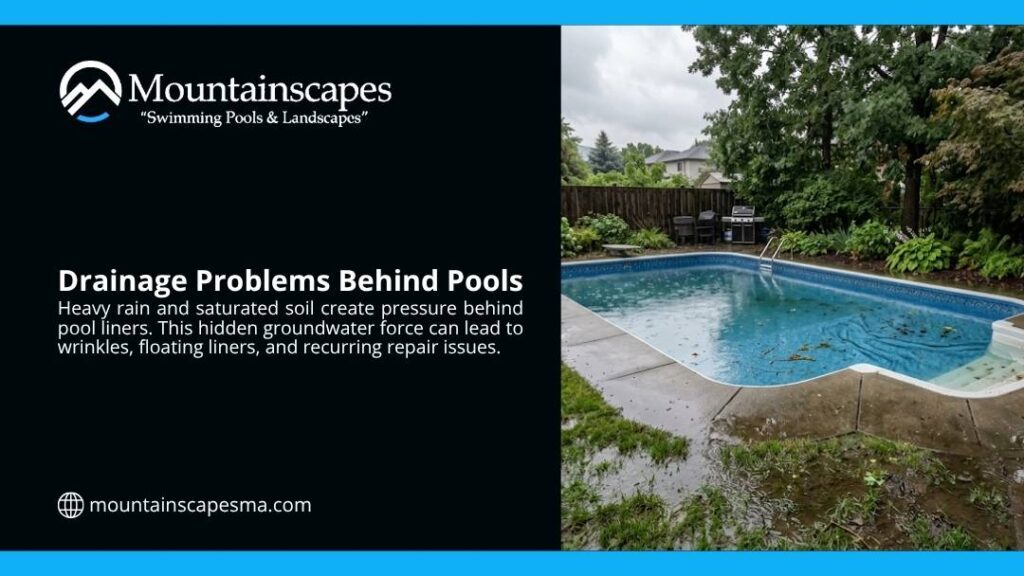
And then there’s drainage, which homeowners almost always overlook. Water building up around the pool shell creates hydrostatic pressure behind the liner. You see it as wrinkles, a floating liner section, or a seam that suddenly looks off.
If your yard tends to hold water after a heavy rain, the liner is fighting that pressure every time the ground saturates. That’s exactly why our team often looks at grading and backyard drainage solutions before we ever recommend a liner job, fix the cause first, not the symptom.
| Cause | Typical Damage | Long-Term Impact |
| UV exposure | Fading and brittleness | Cracking and splitting |
| Chemical imbalance | Dry or stiff vinyl | Weak seams and tears |
| Ground movement | Wrinkles and stretching | Leak formation |
| Sharp objects | Small punctures | Water loss |
| Poor drainage | Floating liner | Structural stress |
| Winter freeze-thaw cycles | Material fatigue | Larger tears over time |
How to Tell If Your Pool Liner Can Be Patched?
Not every leak means a new liner. Plenty of them, caught early, are a one-hour fix. Here’s the rough rule of thumb we use on-site: if the vinyl still feels soft and pliable when you press it, and the damage is in one spot, you’re probably looking at a successful patch. Small punctures, clean tears under three inches, and isolated cuts on a flat wall section; those are the candidates a vinyl patch kit was designed for.
Location matters as much as size, though. A tear on a flat wall is one thing. A tear at a corner, around a return fitting, near the steps, or right on a seam? Those areas flex and shift constantly with temperature swings, so patches there fail at much higher rates. It’s not impossible, just stack the deck against you.
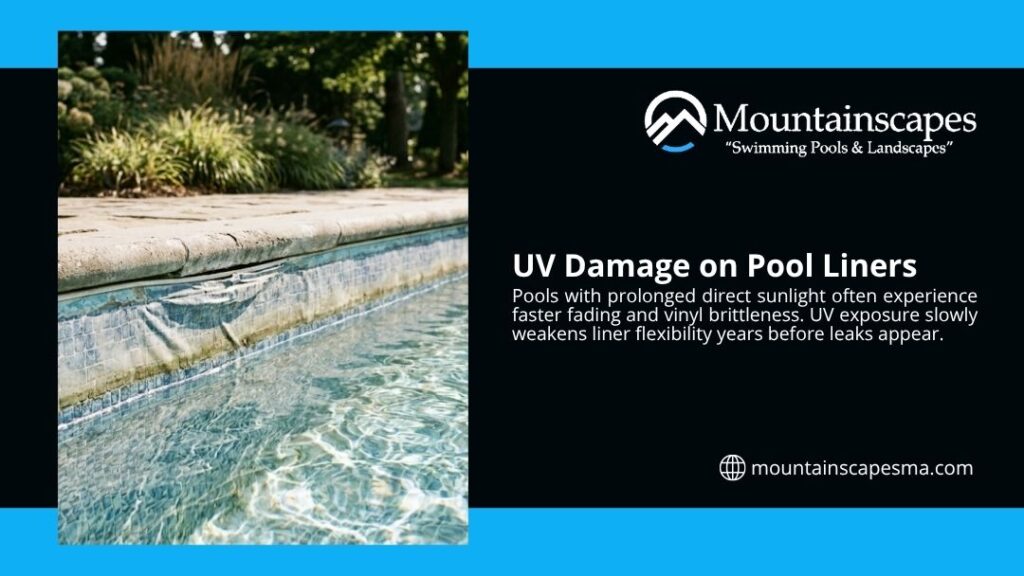
Before patching anything, take 90 seconds and look at the rest of the liner. Faded color, chalky texture, visible stretching, a wrinkled section near the deep end, those are the warning signs that the rest of the liner is on its way out. Repairing one tear when the whole vinyl is fatigued is like patching one shingle on a roof that’s already failing.
| Repair Factor | Good Candidate for Patching | Poor Candidate for Patching |
| Vinyl condition | Flexible and smooth | Brittle and dry |
| Damage size | Small puncture or clean tear | Large split or seam failure |
| Liner age | Under 8–10 years | Over 12 years |
| Leak history | One isolated issue | Multiple repairs already present |
| Surface condition | Minimal fading | Heavy discoloration and wrinkles |
If you’ve patched the same liner more than twice in two seasons, you’ve already answered the question. The liner is telling you it’s done.
Signs You Need a Full Pool Liner Replacement Instead
There’s a moment in every aging liner’s life when one more patch is just delaying the inevitable. We’ve walked into plenty of yards where the homeowner has six patches scattered across the pool floor and walls, and they’re frustrated because the leaks keep coming back.
Here’s what’s happening: the patch is fine. The vinyl around it isn’t. Once the material itself loses its flexibility, every patch becomes a temporary win, because the next failure point is already forming an inch away.
| Warning Sign | What It Usually Means | Why It Matters |
| Faded or washed-out color | UV and chemical wear | Vinyl has lost its flexibility |
| Brittle texture | Aging material | New cracks form easily |
| Wrinkles across the floor or walls | Shifting or stretching | Water may sit behind the liner |
| Repeated leaks | Material fatigue | Repair costs keep adding up |
| Seam separation | Structural liner failure | Patches rarely hold |
| Floating liner sections | Drainage or groundwater pressure | The pool structure may need inspection |
| Multiple patched areas | Widespread wear | Replacement is more cost-effective |
The Pool & Hot Tub Alliance puts the average vinyl liner lifespan at 7 to 15 years, depending on maintenance, climate, and water chemistry. Up here in Massachusetts and New Hampshire? Plan on the lower end of that range. The freeze-thaw cycles, sharp temperature swings, and long winter cover seasons are simply harder on vinyl than what you’d see in Florida or the Carolinas.
If you’re seeing two or three of the warning signs above at the same time, replacement isn’t the expensive option anymore; repeat repairs are. Understanding when to replace your pool liner comes down to recognizing when ongoing fixes start costing more than a full replacement.
How to Patch a Pool Liner Underwater
A lot of homeowners ask if they can patch a pool with water still in it. The answer is yes, and honestly, you usually should. Draining a vinyl pool puts real structural stress on the shell, and in some cases, an empty pool can actually shift or float depending on groundwater conditions. So underwater patching isn’t a workaround. It’s the right method.
Here’s the process we use, step by step:
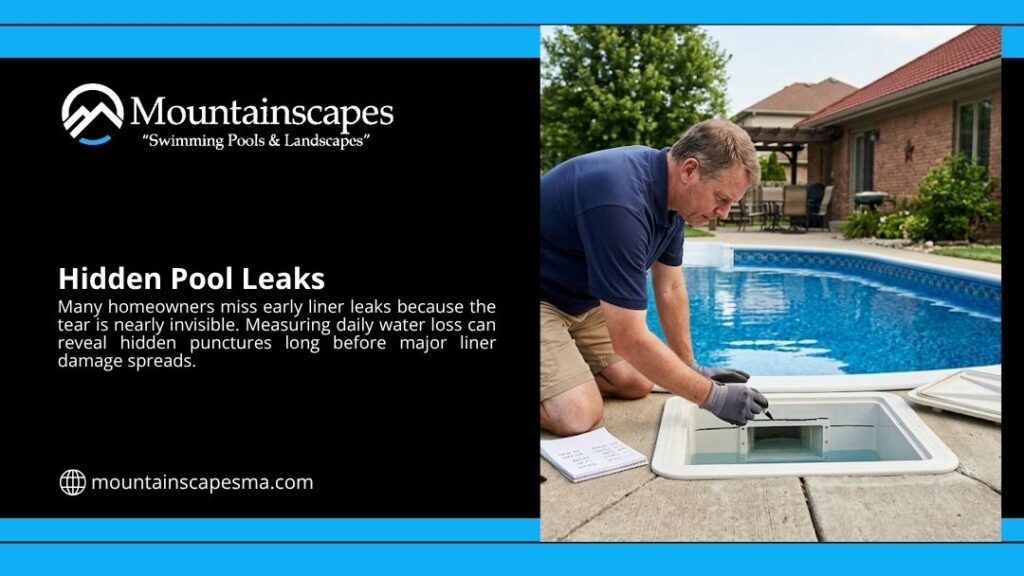
1. Find the leak first: Don’t guess. Add a few drops of dye-test fluid (or food coloring) near suspected areas with the pump off. The dye gets pulled toward the puncture and tells you exactly where to work.
2. Clean the area: Algae, body oils, sunscreen residue, and dirt all kill adhesion. Scrub the surrounding vinyl gently with a soft pad before doing anything else.
3. Cut a rounded patch: Two inches larger than the tear in every direction. Round corners, not square, square corners peel underwater every single time. This is the most common DIY mistake we see.
4. Apply adhesive evenly: Use the vinyl-specific glue from a real pool liner kit. Fold the patch loosely (adhesive-side in) so the glue doesn’t wash off as you submerge it.
5. Press, smooth, hold: Press the patch firmly over the tear, then smooth from the center outward to push out trapped air and water. Hold steady pressure for at least 30 seconds. Most underwater patch kits begin sealing within minutes, but full cure can take up to 24 hours, depending on water temperature.
One thing the YouTube tutorials won’t tell you: a perfect patch on bad vinyl still fails. The technique only works when the surrounding material is healthy enough to bond with the patch. If the vinyl is already dry and crumbling, no kit on the market is going to save it.
How Big a Hole Can You Patch in a Pool Liner?
This comes up constantly. And honestly, how big is the wrong question. A two-inch puncture on a four-year-old liner? Easy patch. A half-inch crack on a fifteen-year-old liner that hasn’t been opened in two seasons? That crack is going to keep spreading no matter what you stick over it. Size matters, but condition matters more. And location matters almost as much as both.
| Damage Type | Typical Repair Outcome |
| Pinhole leak | Excellent repair success |
| Small puncture | Good long-term results |
| Clean tear under 3 inches | Usually repairable |
| Multiple tears | Often temporary at best |
| Seam separation | Replacement recommended |
| Brittle cracking | Replacement recommended |
Damage near steps, returns, skimmers, and corners is on a whole different difficulty level than damage on a flat wall; those areas move with every temperature change, so the patch is fighting flex stress 24/7.
Do Pool Patches Really Work Long Term?
Yes, when they’re done right, on the right liner, they absolutely work. We’ve installed patches on customers’ pools that are still holding strong six and seven years later.
But long-term success isn’t really about the patch itself. It’s about the liner the patch is sitting on. Water chemistry, age, UV exposure, freeze-thaw stress, and how clean the prep work was all decide how long that repair lasts.
This is where most online experts get it backward. They focus on the product and the technique, then act surprised when a repair fails. The patch was never the issue; the liner was already too far gone.
You can do everything textbook-perfect in July and still find a fresh crack opening two inches from the patch the following May, because the freeze-thaw winter finished what the summer started.
Repair vs. Replacement Cost Comparison
Cost is usually what tips the decision either way. A DIY patch can run you $20–$40 in materials. A pro patch with leak detection might run $200–$500. A full liner replacement is typically $3,500 to $5,500+, depending on pool size, liner thickness, and any wall foam or coving work needed.
For homeowners planning a larger upgrade, it also helps to understand how much it costs to build a pool before deciding between repair, replacement, or a full backyard redesign. So on paper, patching wins every time. Except it doesn’t, if you’re doing it three times.
| Issue | Typical Solution | Approximate Cost Range | Long-Term Value |
| Small puncture | Underwater patch | <$50 | Strong |
| Single isolated tear | Professional repair | $100-$300 | Fair |
| Repeated leaks | Multiple patches | Weak | Weak |
| Faded brittle liner | Full replacement | $2k-$7k+ | Strong |
| Seam separation | Replacement | $2k-$7k+ | Best option |
Here’s something worth thinking about: when homeowners do replace a liner, a lot of them use it as the trigger for the bigger backyard project they’ve been putting off, the cracked patio, the drainage that never got fixed, the lighting that was supposed to happen next year.
If the pool area needs a surface upgrade too, comparing a stone patio vs. concrete patio can help you choose the right hardscape before the liner work begins.
A liner replacement gives you natural permission to upgrade the whole space at once, and the coordination usually saves money compared to doing each project separately.
That’s part of why we see so many people exploring custom outdoor living design ideas at the same time as a linear project. And if you’re wondering whether the investment makes sense at all, understanding how a pool increases home value can help you decide before committing either way.
Common Mistakes Homeowners Make When Patching a Pool Liner
A clean repair can hold for years. But most failed repairs we get called in to fix trace back to the same handful of mistakes. The pattern is almost always the same: the homeowner focuses on the visible hole and skips everything around it.
| Common Mistake | What Happens Next | Better Approach |
| Waiting too long to repair a leak | Small tears keep growing | Patch as soon as you notice water loss |
| Skipping surface cleaning | Adhesive won’t bond | Scrub the area thoroughly first |
| Using square-edged patches | Corners peel underwater | Always cut rounded edges |
| Using household glue or duct tape | Repair fails within days | Use a vinyl-specific liner kit only |
| Ignoring water chemistry | Vinyl and adhesive both weaken | Keep chlorine and pH balanced |
| Patching brittle vinyl over and over | New cracks open nearby | Inspect the overall liner condition first |
| Overlooking drainage issues | Pressure keeps building behind the liner | Address grading and site drainage |
Here’s the one most people miss entirely: the surrounding environment. Poor grading, hydrostatic pressure, and shifting soil- none of that goes away just because you sealed a hole. The liner is going to feel that pressure first every single time, and patching it without addressing the cause is like mopping a floor while the faucet is still running.
That’s exactly why we approach pools as part of a complete backyard system, not isolated equipment. The pool, the grading, the drainage, and the surrounding hardscape all influence each other. When one piece is off, the liner is usually the first to show it.
Can You Patch a Pool Without a Patch Kit?
Technically, yes. Practically, you’ll regret it within a week. Vinyl liners need adhesive specifically made for underwater use and chemical exposure. Household glue, Flex Tape, Gorilla Tape, and waterproof epoxy, they all peel, shrink, or chemically break down once they sit in chlorinated water. We’ve seen homeowners pull patches off after three weeks that came up cleaner than the day they were applied. That’s not a repair. That’s a stall.
A proper vinyl pool liner repair kit costs around $15–$25 and includes both compatible vinyl material and underwater-rated adhesive that flexes with the liner. There’s seldom a good reason to skip it.
If you’re in a true emergency, say it’s Friday night, the pool’s dropping an inch a day, and the supply store is closed until Monday, temporary tape can slow the bleed. Just don’t kid yourself that it’s holding past the weekend.
When Professional Pool Repair Makes More Sense
DIY makes sense for clean, isolated, surface-level damage. Past that, you’re often spending money to delay a real fix. Call a pro when you’re dealing with:
- A leak you can’t actually find (slow drops of an inch or more per week with no visible source)
- Recurring leaks after multiple patches
- Seam separation or wrinkles you didn’t have last season
- A floating or shifted liner section
- Signs of water behind the liner (squishy spots, sounds when you walk near the wall, brown staining)
A specialist brings leak detection equipment, pressure testing, electronic detection, and dye tracing in the right sequence, which finds what eyes can’t. And just as importantly, a good contractor evaluates the surrounding environment, not just the pool.
Bad grading, a buried downspout dumping into the pool’s backfill, and settling soil under the deck, these are all things we see contributing to recurring liner problems, and that no patch will ever fix.
This is exactly where having a single design-build contractor pays off. Most pool builders only handle the pool. Most landscapers only handle the yard. At Mountainscapes, we handle excavation, drainage, masonry, landscaping, and pool work in-house, so when something’s off, we can diagnose the whole system instead of pointing fingers at the other guy. Clients work with one team, one point of contact, one unified plan.
If you’re already thinking about a bigger upgrade alongside the repair, our pool and outdoor living gallery is a good place to find direction. And homeowners weighing a larger renovation can review our pool financing options to see what makes sense before committing.
What Homeowners in Massachusetts and New Hampshire Should Know About Pool Liners
Climate is the variable nobody wants to talk about, but it’s the one that decides everything. Pool liners up here have a harder life than liners almost anywhere in the country. Freeze-thaw cycles, snow load, shifting frost, six-month cover seasons, and the constant push-pull between groundwater and pool pressure, all of it works against vinyl, all winter long.
That movement is cumulative. Spring is when most homeowners discover what winter did. New wrinkles in the deep end. A stretched corner near the steps. A leak that wasn’t there in October. By the time you open the cover, the damage is already done.
Then summer kicks in, and UV finishes the job, fading the color, drying the surface, and accelerating fatigue in any spot the winter weakened.
Drainage matters more in New England than almost anywhere else. A pool installed without proper grading and water management is dealing with hydrostatic pressure every time we get a heavy rain or fast snowmelt. That pressure pushes against the liner from outside, and the result is the floating sections, wrinkles, and stretched seams we get called out for every spring.
This is why we evaluate grading, drainage, and the surrounding hardscape every time we look at a liner problem. Sometimes the liner really is just old. But often, fixing the liner without fixing what’s around it just resets the clock on the same failure.
If you’re already planning a liner replacement, this is also the moment to think about whether the rest of the space is keeping up. Plenty of homeowners use the project as a chance to refresh patios, add professionally designed backyard lighting, or rework the planting beds that have gotten away from them. A coordinated approach is almost always cheaper and cleaner than trying to retrofit upgrades later.
FAQs
How long does an underwater patch last?
A properly installed patch on a healthy liner can hold for several years. We’ve seen patches we did six and seven years ago still holding fine. On older or brittle vinyl, the same patch might only buy you a season or two.
How do you find a leak in a vinyl pool liner?
Most professionals combine dye testing, water level tracking, and a careful visual inspection around seams, fittings, and the floor. For slow leaks under an inch a week, a pressure test and electronic leak detection are usually needed.
Can an old, brittle liner be repaired?
Sometimes, temporarily. But once the vinyl is dry, faded, and brittle, new cracks tend to open near any patch within a season or two. At that point, replacement is almost always cheaper over two years than another round of repairs.
What is the best way to patch a pool liner?
Vinyl-specific underwater repair kit, clean prep, rounded patch edges, and steady pressure for at least 30 seconds. And honestly, patching a liner that’s already past its lifespan isn’t the best way to do anything. It’s just delaying a bigger bill.
Will a pool patch survive winter?
On a healthy liner, yes. In Massachusetts and New Hampshire winters, freeze-thaw movement is the toughest test a patch will face, and it’s exactly when older vinyl tends to fail.
Is it worth repairing a 15-year-old liner?
Rarely. By that age, the vinyl has lost most of its flexibility, and any repair is essentially a placeholder until the next leak shows up. Save the repair money and put it toward a replacement that’ll give you another decade.
Can chlorine levels affect patch repairs?
Absolutely. High chlorine and unbalanced pH break down both vinyl and patch adhesive faster than anything else. If your chemistry has been off all season, expect a shorter repair lifespan.
What Makes the Most Sense for Your Pool?
A small puncture on a healthy liner doesn’t justify a $5,000 replacement. We’ll be the first to tell you that. But an old, faded, repeatedly-patched liner doesn’t justify another $40 repair, either.
That’s the math homeowners get wrong most often, chasing one cheap repair after another while the actual cost piles up in lost water, lost chemistry, lost swim days, and the eventual replacement that was coming anyway.
The smart decision isn’t always the cheapest one this week. It’s the one that protects your pool, your yard, and your weekends for the next decade.
Here’s how we approach it at Mountainscapes: every pool sits inside a larger system. Drainage, grading, hardscape, landscape, and lighting, it all influence how the liner performs season after season.
A leak is sometimes just the visible piece of something bigger underneath. Catching it early, fixing the cause and not just the symptom, and making decisions based on the whole picture is what separates a five-year fix from a fifty-dollar Band-Aid.
If your liner is leaking again, feels brittle when you touch it, or is showing the signs we walked through above, it’s worth a real conversation. Whether you need a clean repair, a full replacement, or you’ve been thinking about reimagining the whole backyard, our design-build approach keeps the whole project under one roof and one point of contact.
Reach out to the Mountainscapes team for a straight-shooting assessment. Sometimes the answer is a patch. Sometimes it’s a new liner. Sometimes it’s a backyard that finally lives up to what you’ve been picturing. The best fix isn’t always another patch. Often, it’s a smarter plan.