

If you’ve been watching your liner lose color for the past two seasons or noticed a waterline that keeps dropping a little faster than it should, you already know something is off. The question most homeowners sit on too long is when is the best time of year to replace a pool liner?
The short answer: late spring or early fall, when daytime temperatures sit close to 70°F. Vinyl needs that mild range to stretch and settle properly during installation. But the timing decision runs deeper than temperature; it touches on contractor availability, your family’s summer plans, and whether other backyard repairs should be done at the same time.
This guide walks through each season honestly, explains what temperature does to vinyl during a liner install, covers how long liners realistically last in New England climates, and flags the preparation mistakes that shorten liner life faster than anything else.
Best Time of Year to Replace a Pool Liner
Most pool professionals in the Northeast land on the same window: late April through mid-June, and again in September through mid-October. That’s not arbitrary. Vinyl liner material is temperature-sensitive in ways that affect the actual fit and long-term wear, not just how comfortable it is for the crew working outside.
Vinyl liners need mild weather to fit cleanly. Pool & Spa News notes that when temperatures drop below about 60°F, a vinyl liner can become stiff and uncooperative, which makes it harder to seat the material around corners, steps, and transitions.
A vinyl liner installation guide also recommends installation at 60°F or higher. That’s why spring and early fall are usually safer windows for replacing a pool liner in Massachusetts and New Hampshire: the liner has enough flexibility to settle properly, without the scheduling pressure and heat of peak summer.
Why Spring Is the Most Popular Season
Spring runs the calendar for pool liner replacements in New England, and the reason is pretty simple: families want the pool open and ready before school lets out. That pressure, completely understandable, pushes most scheduling calls toward April and May.
There’s also a practical benefit to spring work that doesn’t get mentioned enough. Groundwater levels tend to stabilize after the winter thaw, which means the pool floor is more predictable when crews pull the old liner and inspect what’s underneath.
In areas with drainage issues, waiting until the ground dries out can actually reveal movement or soft spots that would otherwise stay hidden and cause problems with the new liner within a season or two.
Spring also makes it easy to fold in other backyard improvements at the same time. Patio work, drainage corrections, and shrub planting, contractors are already mobilized, the ground is workable, and you avoid bringing different crews back in June.
The one real downside to spring: demand is high. Companies in colder states fill their spring schedules fast. If you call the first warm weekend in March, hoping to be in the water by Memorial Day, expect longer lead times than you’d get booking in the fall.
Why Fall Can Be a Smart Choice
September doesn’t get nearly enough credit for pool liner work. Temperatures in early fall across Massachusetts and New Hampshire regularly hold in that 65–72°F range that installers prefer.
Crew schedules open up after the summer rush. And the pool gets closed for winter shortly after, which means the new liner sits protected rather than being immediately exposed to sun and chemicals.
Think about the math from the homeowner’s side: a fall replacement means the pool reopens in spring with a fresh liner already in place. No waiting, no lost swim days in June, no scrambling to schedule work during the busiest stretch of the season.
There’s something else worth knowing. Emergency replacement calls spike in July and August because that’s when liners fail under use pressure. Contractor availability tightens, material lead times stretch, and the stress of losing your pool mid-summer adds up. Booking in September sidesteps all of that, and some homeowners find they can negotiate better scheduling flexibility when the rush has passed.
Why Summer Replacement Can Be Difficult
It feels like summer should be fine for liner work. The weather is warm, the ground is dry, and vinyl should be plenty flexible in the July heat. In practice, summer is often the hardest time to actually get the project done well.
Contractors are managing maintenance calls, emergency repairs, and installation backlogs all at once. Lead times for custom-measured liners run 2–4 weeks regardless of season, so a liner failure in early July can genuinely cost a family most of the swim season.
There’s also a heat problem; if a liner fails during extreme temperatures and the pool floor is exposed for any length of time, older vermiculite or concrete bases can dry and crack faster than expected. That turns a liner swap into a floor repair job.
Summer replacements happen; sometimes they’re unavoidable, but counting on a smooth summer install usually means planning it in late May or early June before peak demand hits.
Why Winter Usually Isn’t Ideal
Cold-weather installs exist, but they’re almost always emergencies rather than planned upgrades. Vinyl becomes stiff below 50°F, which makes vacuum-fitting around corners and stairs genuinely difficult. Wrinkles that would smooth out in mild conditions tend to stay locked in.
In northern New England, winter also adds complications beyond the liner itself, frozen ground, elevated groundwater pressure, and snow removal around the work area. Most pool companies either decline winter liner projects outright or require climate-controlled enclosures to do the work properly.
If a liner fails mid-winter and you’re losing water, a temporary patch usually makes more sense than rushing a replacement. Wait for the temperature window, schedule correctly, and the installation goes smoother.
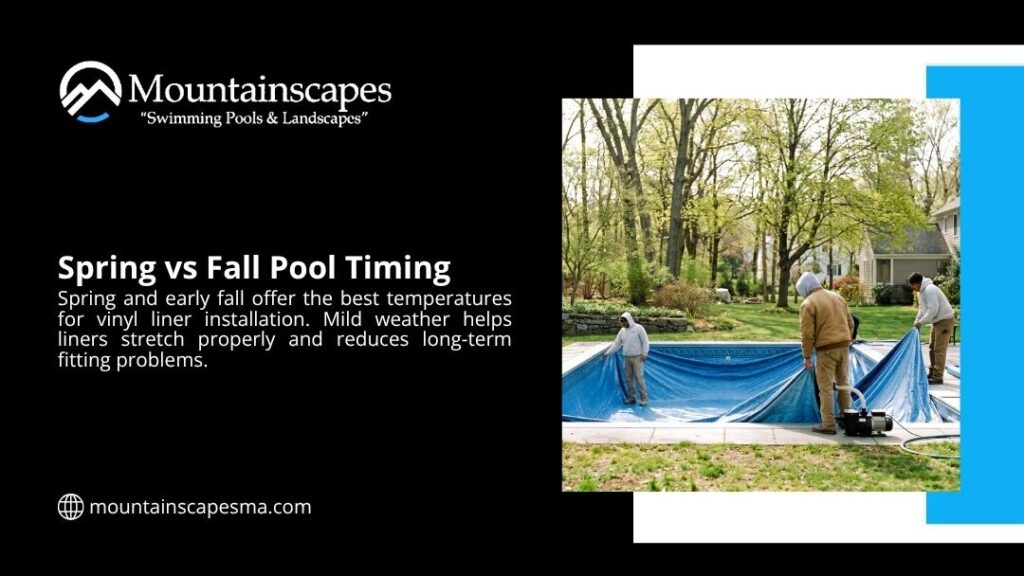
Why Temperature Matters During Pool Liner Replacement
Temperature affects every stage of a liner installation, including how the material handles, how well it seats against the pool walls, and how long it holds that shape after refill.
| Temperature Range | What It Means for Installation |
| Below 60°F | Vinyl stiffens and resists movement; corners and stairs are harder to fit cleanly |
| 65°F – 75°F | Ideal. Material is flexible without being overstretched. Vacuum seating works properly |
| Above 85°F | Risk of overstretching increases. Material may pull too far and settle unevenly once it cools |
Why 70°F Is the Target
At around 70 degrees, vinyl has the right balance, flexible enough to smooth across complex shapes, stable enough that it won’t distort once the water goes in. Installers can take their time working wrinkles out of corners and deep transitions without the material fighting them.
That balance matters for liner longevity. A liner installed in poor conditions might look fine at first and then show bead separation or uneven wear two seasons in, problems that trace directly back to the original fit.
What Happens If It’s Too Cold
Cold vinyl is stiff vinyl. It resists stretching in the places where pools are most complex, around steps, in the deep end transition, and along the walls near fittings. Crews may need heaters, temporary enclosures, or simply more time to work the material into place. That added labor shows up in cost.
What Happens If It’s Too Hot
Excessive heat stretches the liner during installation. Once the temperature drops, and in New England it will, the material contracts and may not settle correctly. Overstretched seams are weaker seams. The liner may pass inspection in August and start showing stress in October.
Signs It’s Time to Replace Your Pool Liner
Pool liners rarely give up all at once. The warning signs build across seasons, and they’re easy to rationalize: a little fading, a small wrinkle, a waterline that’s maybe slightly lower than it was last year. In New England, especially, freeze-thaw cycles put seasonal stress on vinyl that accelerates the timeline.
Catching these signals before a full failure matters. Liner replacements that happen on schedule are planned, priced, and coordinated around your calendar. Emergency replacements happen in July when everyone else needs the same contractor.
| Warning Sign | What It Usually Means | Why It Matters |
| Fading or discoloration | UV and chemical exposure over the years | Vinyl may be turning brittle under the surface |
| Wrinkles across the floor | Groundwater movement or overstretching | Often precedes tearing, especially in wet springs |
| Cracks near corners or steps | Aging vinyl under repeated stress | Small splits spread quickly once they start |
| Unexplained water loss | Hidden leak somewhere in the liner | Soil beneath the pool may already be saturated |
| Loose liner bead | Shrinkage from age or chemical imbalance | The liner may no longer seat correctly |
| Stains that won’t clean | Material deterioration below the surface | Structural integrity often follows shortly after |
| Soft spots underfoot | Floor damage or moisture beneath the liner | Could signal a structural issue, not just the liner |
Many homeowners wait until active leaking forces the issue. By then, the pool floor or surrounding ground may need additional work before a new liner even goes in, work that costs more than the liner itself. Evaluating drainage, grading, and hardscape conditions before replacement is worth doing once, carefully, rather than skipping and redoing it.
How Long Does It Take to Replace a Pool Liner?
The installation itself, pulling the old liner, prepping the surface, and setting the new one, usually runs one to two days. The full project almost always takes several weeks because custom liners have to be manufactured after measurements are taken.
| Stage | Typical Timeline |
| Pool measurement | 1 day |
| Custom liner manufacturing | 2 – 4 weeks |
| Old liner removal | Several hours to 1 day |
| Surface preparation and repairs | 1 – 2 days (varies) |
| New liner installation | 1 day |
| Pool refill | 2 – 5 days depending on size |
Measuring and Ordering
Every custom liner is built to the pool’s specific dimensions. Pools with benches, tanning ledges, or irregular shapes require more time to measure accurately, and those measurements need to be right. A liner built to incorrect specs either won’t fit or will develop stress points early.
Drain, Remove, and Inspect
Once the pool is drained, crews remove the old liner and examine what’s underneath. Older pools sometimes reveal deteriorated vermiculite floors, cracked wall panels, or plumbing issues that weren’t visible before. This inspection is worth slowing down for; rushing past it is how homeowners end up replacing a second liner within five years.
Repairs Underneath the Liner
This stage gets skipped or minimized more than it should. Floor repairs, drainage corrections, and wall panel fixes done before installation protect the liner long-term. Projects that treat the liner as the only component, ignoring the environment around and beneath it, tend to have shorter lifespans.
Installation and Refill
Industrial vacuums pull air from between the liner and the pool shell, settling the material into place before water goes in. Refilling takes longer than most people expect, two to five days for a typical inground pool, depending on local water pressure and pool volume.
How Long Does an In-Ground Pool Liner Last?
Most vinyl liners hold up between 8 and 15 years. Where a specific liner falls in that range depends on water chemistry, sun exposure, how the pool was winterized each year, and, in New England, how hard the freeze-thaw cycle hits it.
According to the industry data and former Association of Pool & Spa Professionals (now the Pool & Hot Tub Alliance), pool renovation has become a major part of the swimming pool industry as homeowners increasingly choose to renovate existing pools rather than replace them entirely. The organization noted that renovation work expanded significantly as homeowners looked to extend the life of older residential pools.
| Pool Liner Type | Typical Lifespan |
| Standard vinyl liner | 8 – 12 years |
| Premium vinyl liner | 12 – 15 years |
| Heavier commercial-grade vinyl | 15+ years |
Water Chemistry and UV
Chlorine levels that run too high and pH that sits too low gradually break down the vinyl from the inside out. Fading patterns and damaged seams are usually chemical problems before they’re age problems. UV exposure adds to that; darker liners absorb more heat, which can accelerate surface wear in full-sun pools.
Winterization and Maintenance
How a pool gets closed each fall matters more than most homeowners realize. Proper water balance before closing, correct plugging of returns and skimmers, and appropriate cover tension all affect how the liner handles five months of freeze cycles. Consistently done, it extends liner life. Consistently skipped, it cuts years off.
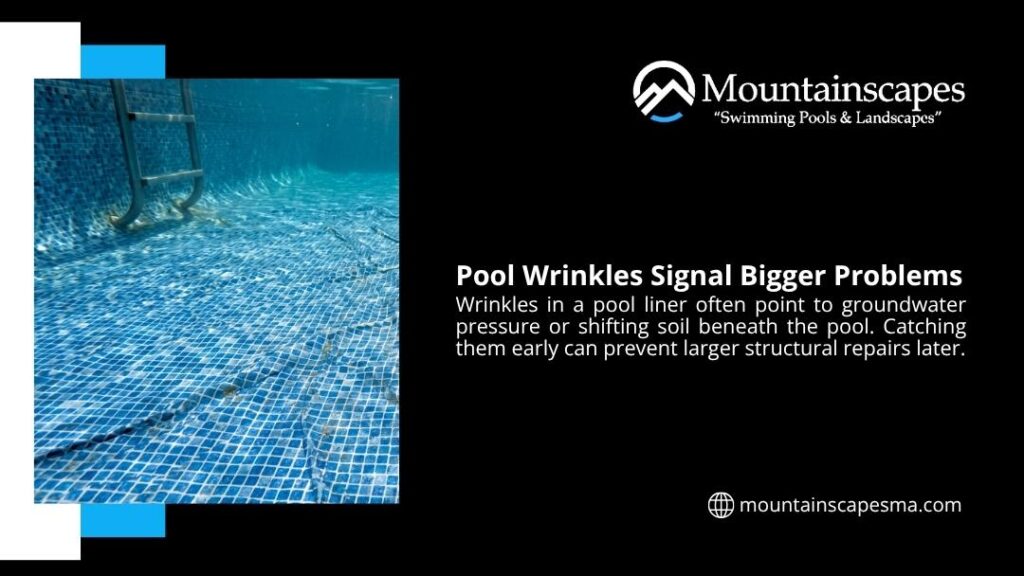
Replace Inground Pool Liner or Repair It?
Small, isolated tears, especially away from seams and fittings, can sometimes be patched successfully with underwater repair kits. A patch done correctly on a liner that’s otherwise in good shape might buy another season or two.
But a liner that’s become brittle, has multiple leak points, or is showing widespread shrinkage usually can’t be saved by patching. Each repair holds for a while, then fails at the next weak point. At some point, you’re spending money on patches for a liner that was going to need replacement anyway.
When the Real Problem Isn’t the Liner
Here’s what often catches homeowners off guard: sometimes the liner isn’t actually the root cause. Drainage failures around the pool, settling hardscaping, or persistent groundwater pressure beneath the floor can damage liners after a liner if the underlying conditions aren’t addressed.
At Mountainscapes, projects get evaluated as complete outdoor environments, not just the pool itself. Liner replacements often surface drainage or grading issues that, addressed at the same time, prevent the same problems from recurring with the new liner.
What Homeowners Miss Before Replacing an In-Ground Pool Liner
Liner replacement doesn’t happen in a vacuum (pun aside). The condition of the yard, hardscape, and drainage system around the pool affects how the new liner holds up, sometimes more than the liner material itself.
Drainage Problems Around the Pool
Groundwater that pools around the pool base after heavy rain creates pressure beneath the floor. Over time, that movement shows up as wrinkles and shifting that look like liner problems but are actually ground problems. Addressing drainage before, not after, a liner replacement protects the investment.
Coping and Hardscape Condition
Cracked coping or uneven pool decking sometimes indicates movement in the surrounding soil. Homeowners planning renovations often evaluate patio surface choices during this window, whether that’s natural stone, concrete, or pavers, because replacing the liner and leaving deteriorating hardscape in place creates a mismatch that usually leads to another project the following year.
Lighting and Landscaping
Liner replacement exposes fittings and fixtures that are otherwise inaccessible. That’s a natural time to update underwater lighting, inspect return fittings, or address irrigation lines that run too close to the pool. Coordinating landscaping during the same project avoids duplicate work and protects new planting beds from construction damage.
Financing Larger Renovations
Some homeowners, once they’re already committed to a liner replacement, decide to evaluate what else makes sense to bundle. Patio improvements, drainage work, and outdoor lighting upgrades done in one coordinated project cost less than separate mobilizations and create a more cohesive finished result. Financing options can make those decisions easier to act on.
Pool Liner Replacement Cost Factors
Liner replacement pricing varies widely. Pool size, shape complexity, material grade, and what gets discovered underneath the old liner all drive the final number. The table below covers the main factors; exact pricing depends on site-specific conditions.
| Cost Factor | Impact on Pricing |
| Pool size and volume | Significant (larger pools require more material and labor) |
| Custom or freeform shape | Moderate to high (complex shapes take longer to measure and manufacture) |
| Deep end depth | Moderate (affects material quantity and installation complexity) |
| Floor or wall repairs needed | Significant (can equal or exceed liner cost depending on condition) |
| Water delivery costs | Moderate (varies by location and municipal access) |
| Pattern and material upgrade | Moderate (premium liners run noticeably higher than standard) |
Homeowners who already plan backyard improvements sometimes compare broader pool construction costs to evaluate long-term renovation investments.
Spring vs Fall Pool Liner Replacement
Neither season is wrong. The better choice usually comes down to how the pool fits into your family’s schedule and how much lead time you have to plan.
| Factor | Spring | Fall |
| Pool readiness | Ready before swim season starts | Ready before next year, no lost swim days |
| Contractor demand | High, book early | Lower, easier scheduling |
| Wait times | Longer lead times are common | Often more flexible |
| Best for | Families prioritizing summer pool use | Homeowners planning or bundling projects |
| Temperature conditions | Generally reliable in May | Often excellent in September–October |
Pool installers often note that spring appointments book out fast precisely because experienced contractors know what fall availability looks like. In areas with drainage concerns, a common condition in New England after snowmelt, spring timing also gives crews a clearer read on groundwater behavior before the liner goes in. A floor that looks stable in summer may tell a different story in April, and catching that before installation is worth the earlier scheduling.
Does Replacing a Pool Liner Increase Home Value?
A stained, wrinkled liner is one of the first things a buyer notices, and one of the easiest things for them to use as a negotiation point. A fresh liner removes that objection immediately.
Whether it adds measurable dollar value on its own depends on the market. What it reliably does is improve buyer confidence, make the backyard photograph better, and remove a condition item from a home inspection. Paired with updated landscaping and lighting, the effect on first impressions is significant.
Questions Homeowners Ask Before a Pool Liner Replacement
What month is best to replace a pool liner?
Late April through May and again in September through early October. Both windows offer the mild temperatures that vinyl installation requires, but availability and scheduling differ between them.
How much water is needed after replacement?
A complete refill. Inground pools are filled from scratch after liner installation, which can take two to five days depending on pool volume and local water pressure.
Can wrinkles be repaired without a full replacement?
Occasionally, small, isolated wrinkles sometimes respond to professional vacuum adjustment. Widespread wrinkles across the floor almost always indicate that the liner has stretched past the point where correction is practical.
Can a pool liner tear without warning?
It can seem that way, but the brittleness usually builds over time. Older liners become less elastic and tend to fail at stress points, around stairs, at fittings, or along seams, often during a season where water temperature swings are particularly sharp.
Is liner replacement usually part of a larger renovation?
More often than not. Once the pool is drained and the liner is out, it’s a natural time to address coping, patching, lighting, and any drainage or hardscape issues that affect how long the new liner lasts.
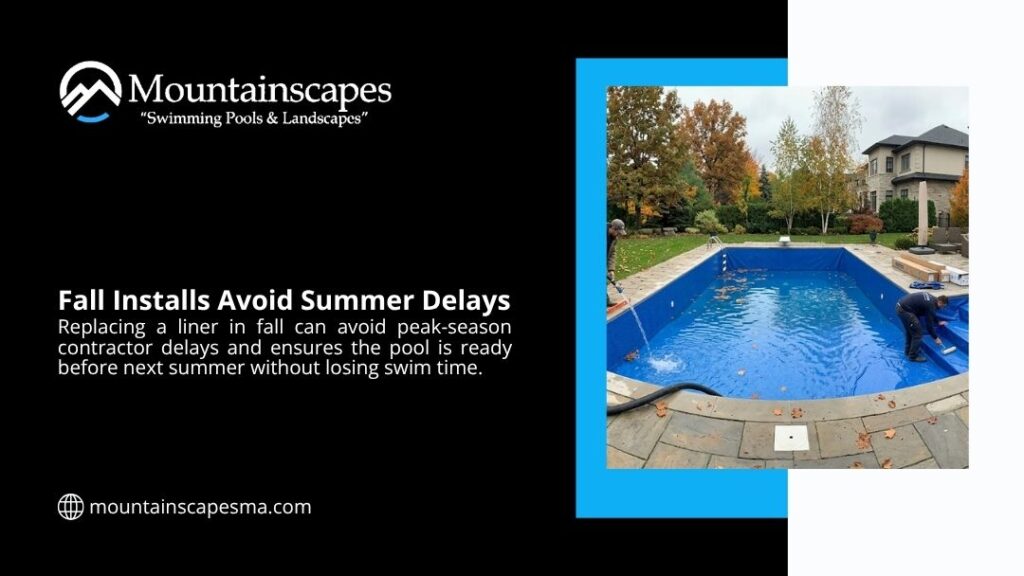
Planning Usually Saves the Most Stress
The homeowners who handle liner replacement smoothly are almost always the ones who planned it before the liner failed. Waiting until mid-July after a visible leak means competing with every other emergency call in the queue, losing most of the swim season, and making decisions under pressure.
Spring and early fall remain the best time of year to replace a pool liner, with mild temperatures, workable ground conditions, and a schedule that doesn’t interrupt summer. For homeowners thinking about larger backyard improvements alongside a liner replacement, timing those projects together typically produces better results and saves money compared to separate mobilizations a year apart.
For homeowners in Massachusetts and New Hampshire looking for guidance on pool liner replacement, outdoor renovations, or backyard planning, the team at Mountainscapes evaluates the full outdoor environment, not just the liner, to make sure the investment holds up for years.
Ready to plan your liner replacement? Contact Mountainscapes to schedule a site consultation, and we’ll evaluate your pool, the surrounding environment, and help you time the project for the best outcome.