

A French drain handles water hiding underground. A catch basin handles water sitting on top of it. Get those mixed up, and you’ll spend $5,000 on the wrong system, then watch your driveway flood again the next time we get a real spring thaw. Both move water. They just don’t move the same water.
This guide walks you through the difference and which one your yard actually needs, based on what 13+ years of digging trenches across Massachusetts and New Hampshire has taught us about how water really behaves in New England soil. Towns like Andover, Tewksbury, Bedford, Nashua, Pelham, and Windham all have their own quirks (clay-heavy lots, glacial till, ledge an inch under the topsoil), and the right answer changes based on what’s actually under your grass.
French Drain vs Catch Basin: Which Do I Need?
Most people start searching for this exact question right after a bad storm. It’s almost always the same scene. The lawn’s been a swamp for four days. There’s a wet ring along the foundation that wasn’t there last year. The mulch by the front walk got moved three feet by the runoff. Or worse, the basement smells foul, and the dehumidifier is running constantly.
None of that fixes itself. And every winter, we ignore it; freeze-thaw makes it worse. The confusion is fair, because both systems move water, and the names don’t make the difference obvious. But here’s the part that decides everything:
A French drain controls groundwater that’s hiding beneath the surface. A catch basin collects water that’s sitting on top of it. That single distinction changes the install depth, the cost, the maintenance, and which one keeps your driveway from icing over in February.
| Drainage Problem | Best Solution |
| Lawn that stays soggy for 3+ days after rain | French drain |
| Water pooling on the driveway or patio | Catch basin |
| Damp foundation or basement walls | French drain |
| Runoff sheeting off the pool deck | Catch basin |
| Squishy spots in the lawn that never dry out | French drain in the yard |
| Standing water near walkways or garage entry | Catch basin drainage |
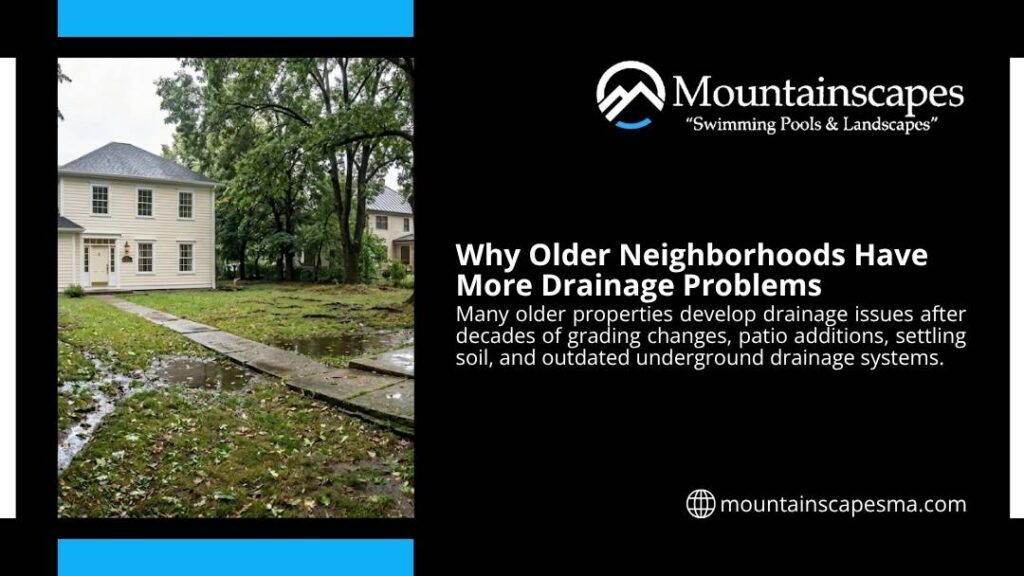
Here’s what we run into constantly across older MA and NH neighborhoods: the property has both problems at once. Surface runoff overwhelms the driveway and underground saturation, choking the lawn, and the two feed each other. That’s especially common on lots from the 1960s and ’70s, where grading has shifted three or four times over decades, and clay-heavy subsoil holds water like a sponge.
A drainage system isn’t just about making puddles disappear. It’s protecting the foundation, the patio, the retaining wall, the lawn, and the pool deck from damage you won’t see for years. Until you do.
What Is a French Drain and What Is It Used For?
A French drain is a trench filled with washed stone, a perforated pipe sitting inside that stone, and a layer of filter fabric wrapped around the whole thing to keep silt out. Water seeps down through the soil, finds the gravel, falls into the pipe, and runs downhill to a discharge point, usually a lower spot in the yard, a daylight outlet, or a dry well. The whole point? Relieve underground water pressure before it does damage you can’t see.
Most homeowners assume puddles are a surface issue. They’re not, usually. The puddle is just where the water finally became visible; the actual problem is what’s happening 4 to 24 inches below it. Saturated soil. Hydrostatic pressure pushes against the foundation. Subsurface flow erodes the base of a retaining wall at one millimeter a year.
You don’t see any of that until something cracks. A French drain in a yard usually goes in along a foundation wall, behind a retaining wall, across a low lawn section, or around a pool deck where the soil stays wet long after the surface dries.
In clay soil, which is most of southern NH and a big chunk of Middlesex County, water has nowhere to go on its own. The drain gives it somewhere to be.
| French Drain Component | What It Does |
| Perforated pipe | Carries collected groundwater away |
| Washed gravel trench | Let the water move through the soil into the pipe |
| Filter fabric (geotextile) | Keeps fines and silt from clogging the gravel |
| Sloped install (1/8″ per foot minimum) | Keeps water flowing, doesn’t sit |
| Outlet or dry well | Discharges water somewhere safe |
Where French Drains Actually Earn Their Keep in New England
A few patterns we see over and over:
| Common Issue | What’s Really Going On |
| The lawn stays saturated for days after rain | Clay subsoil + flat grade + nowhere for water to escape |
| Damp foundation or wet basement walls | Groundwater pressing against the footing |
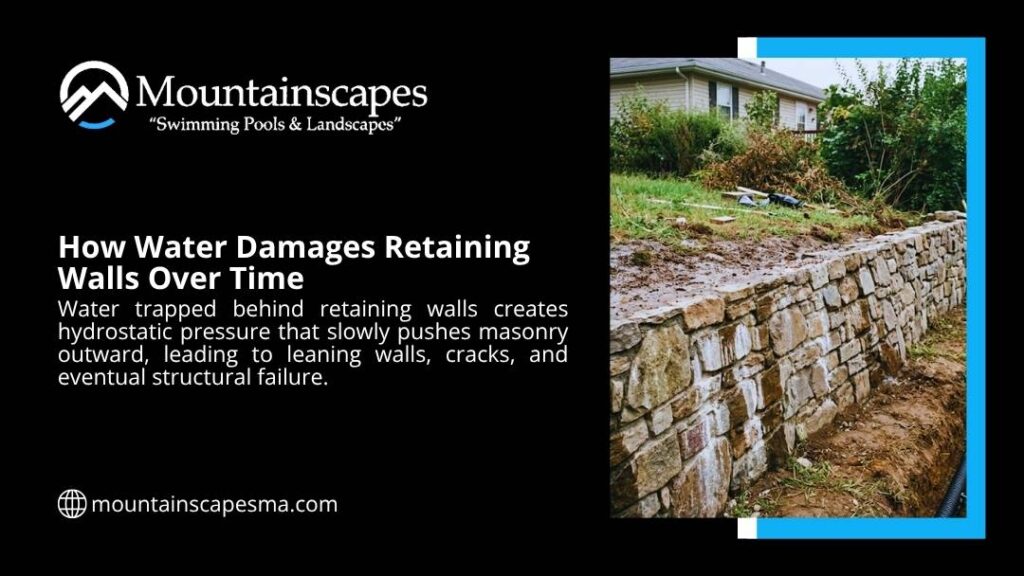
| The retaining wall is starting to lean or weep | Hydrostatic buildup behind the wall |
| The pool deck stays wet long after the pool’s covered | Subsurface saturation around the shell |
| Erosion along a slope after every storm | Subsurface flow undercutting the topsoil |
The EPA flags poor stormwater drainage as one of the top contributors to erosion and structural deterioration in residential properties, and proper site drainage is one of the simplest ways to head it off.
That hits different up here. Freeze-thaw cycles take any drainage weakness and amplify it every winter. Water freezes, expands, refreezes, expands again. A drainage problem that’s mildly annoying in August becomes a cracked walkway by April.
We’ve seen plenty of patios get pushed up two inches in a single winter because nobody addressed what was happening below them. If you are already comparing patio materials, understanding the stone patio vs concrete patio can help you understand how drainage affects long-term performance.
A backyard French drain also protects the expensive stuff, such as patios, pools, retaining walls, outdoor kitchens, and lighting transformers buried in the lawn. A lot of the calls we get for “my pool deck is moving” turn out to be a drainage problem first, a hardscape problem second.
If you’re already seeing signs of trouble, signs your backyard needs a drainage system, highlight the warning signals worth catching early.
What Is a Catch Basin Drain?
A catch basin is the grated box you’ve probably seen sunk into a driveway, patio, or low spot in the lawn. Water hits the surface, finds the lowest point, which is the basin, falls through the grate, drops into a chamber, and gets routed underground through a solid pipe to a discharge point.
It’s surface drainage. Above-ground, fast-acting, visible. Where a French drain works slowly and quietly underground, a catch basin works the second a raindrop hits it.
| Catch Basin Component | What It Does |
| Surface grate | Let’s water in, block leaves and debris |
| Sediment chamber (sump) | Catches dirt, mulch, and silt before they enter the pipe |
| Outlet pipe | Solid (not perforated), moves water to discharge |
| Trap or filter | Slows debris from reaching the outlet line |
Where Catch Basins Earn Their Keep
A catch basin makes sense anywhere water moves fast across a hard surface. Driveways. Pool decks. Patios. Walkways. Anywhere asphalt, concrete, or pavers cover what used to be absorbent ground.
Picture this: after a hard summer storm, water comes off a 1,000-square-foot pool deck in sheets. The compacted lawn around the deck can’t soak that volume up fast enough. So the water keeps moving, finds the lowest point, and pools against the back foundation or the basement walkout. A catch basin at the bottom of the deck intercepts that runoff before it ever reaches the house.
| Surface Problem | Why a Catch Basin Solves It |
| Driveway flooding during heavy rain | Captures sheeting runoff before it spreads |
| Patio with a slow-draining low spot | Removes pooled water at the source |
| Pool deck staying slick after rain | Pulls runoff before it puddles |
| Ice patches form in the same spot every winter | Prevents the meltwater pool from refreezing |
| Erosion at paver edges | Controls concentrated runoff before it cuts a channel |
One pattern we see constantly near older paver patios in homes: the patio settled a quarter-inch over the years, the slope changed, and now water collects in one spot at the back edge. By the second winter, you’ve got a freeze-thaw crack running through the paver field. A single catch basin in the right spot would have prevented all of it.
Catch basins are especially important in modern outdoor living spaces because hardscape coverage has gone up over the last twenty years, with bigger patios, larger pool decks, and expanded driveways. All of that adds to the runoff volume. Less ground absorbing, more water moving.
If you’re planning a bigger renovation, drainage usually gets folded into custom landscape construction work, solving water issues before the patio gets poured, not after.
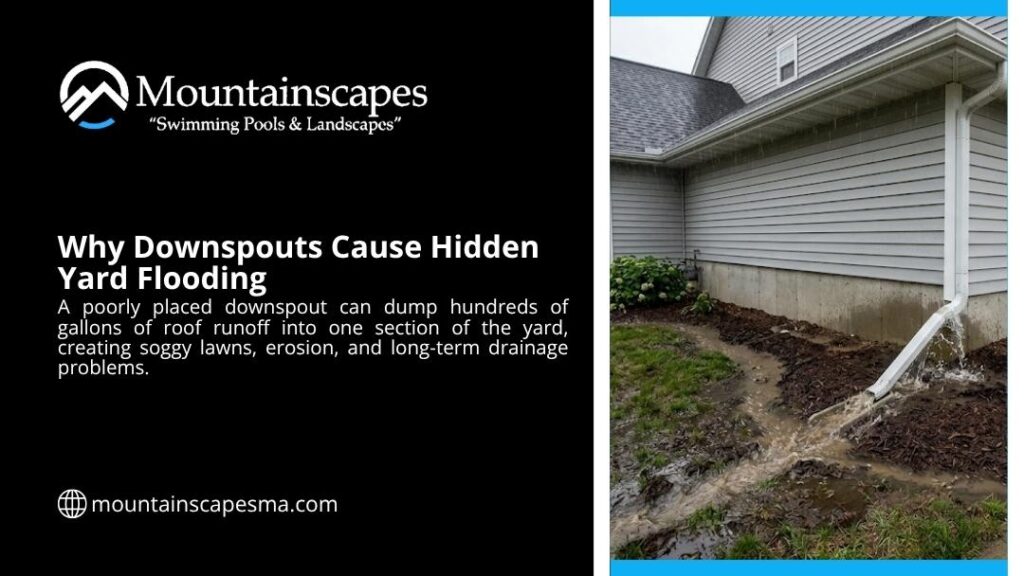
French Drain vs Catch Basin: Side-by-Side Comparison
The biggest misunderstanding in the French drain vs catch basin debate is assuming they compete against each other. They don’t. They solve separate drainage problems.
| Feature | French Drain | Catch Basin |
| What it handles | Underground water | Surface runoff |
| Install depth | 18–36 inches typically | At grade level |
| Best for | Saturated soil, foundation moisture | Fast runoff on hard surfaces |
| Pipe type | Perforated (water enters through holes) | Solid (water enters through the grate) |
| Typical placement | Lawns, foundations, retaining walls, slopes | Driveways, patios, pool decks |
| How water gets in | Soil infiltration through gravel | Direct surface intake |
| Maintenance level | Low, once or twice a decade | Higher, annual cleaning is typically |
| Symptom it solves | Soggy lawn, damp basement | Standing water, ice patches |
French drains work slowly. They relieve pressure underground for hours and days. Catch basins work instantly; the second water hits the grate, it’s gone. That’s why a lot of New England properties end up needing both. A catch basin handles the surface flood from the storm. A French drain handles the saturation that lingers afterward.
When a French Drain Makes More Sense
A French drain is the right call when water can’t move through the soil fast enough on its own. That’s most of New England, honestly. Clay-heavy soil is the default condition across huge chunks of MA and southern NH.
Glacial till makes it worse; the soil’s full of compacted fines and small stones that water has to push around to escape. Dig a hole in your yard, fill it with water, and watch how long it takes to drain. If it’s more than an hour, you’ve got soil that’s working against you.
| Warning Sign | What’s Probably Happening |
| The lawn stays mushy for 3+ days after rain | Subsurface saturation, no escape path |
| Damp foundation or wet basement | Groundwater presses the footing |
| Retaining wall weeping or leaning | Hydrostatic buildup behind the wall |
| Basement humidity that won’t quit | Constant moisture wicking through concrete |
| Erosion gullies along a slope | Subsurface flow undercutting the topsoil |
A French drain installed correctly handles all of that, quietly, year after year. This matters extra when there’s a pool involved. Water pressure under a pool deck slowly destabilizes the surface.
We’ve been on jobs where the deck cracked, the coping shifted, and the homeowner blamed the masonry, when the actual culprit was water pressure that nobody addressed during the original install.
Drainage planning before construction is what separates a pool that looks great in year 12 from one that’s visibly failing in year 5. It’s part of why we evaluate drainage before any major outdoor build. See pool installation services for how that fits into the overall process.
When a Catch Basin Is the Better Option
A catch basin earns its place when water’s moving fast across the surface, and there’s nowhere for it to soak in. Driveways. Pool decks. Patios. Walkways. Sloped hardscapes. Anywhere a sealed surface forces water to keep moving until it finds a low spot.
Here’s the thing about water: it always picks the easiest path downhill. When that path runs across asphalt, pavers, or concrete, it picks up speed and volume fast. By the time it reaches the grass, the lawn can’t absorb it quickly enough, and you’ve got a flood. A catch basin breaks that flow at the source.
| Surface Problem | What the Catch Basin Does |
| Driveway flooding during heavy storms | Intercepts runoff before it pools |
| Patio standing water in the same spot | Removes the puddle before it sits |
| The pool deck is slick for hours after rain | Pulls surface water immediately |
| Same ice patch every January | Prevents the meltwater from refreezing there |
| Erosion at paver or asphalt edges | Controls concentrated runoff before it cuts |
Modern outdoor spaces especially need this. A backyard with a 600-square-foot patio, a 1,200-square-foot pool deck, and a 700-square-foot driveway is generating a lot more runoff than the same property with a small concrete patio did thirty years ago. More hardscape, less ground absorbing. The math doesn’t work without help.
Do Some Properties Actually Need Both?
Yes. And honestly, most of the homes we work on do. A French drain plus catch basin combo solves a problem that single-system installs can’t, because surface runoff and underground saturation almost never exist independently. They feed each other.
Here’s how it usually plays out on real properties: A heavy storm hits. Driveway floods, pool deck sheets water everywhere, and runoff overwhelms the lawn. Excess water that doesn’t run off ends up soaking deep into the soil.
The lawn stays saturated for three or four days. Pressure builds underground. Then the next storm comes, the saturated soil can’t take any more, and surface flooding gets worse than the first time. One problem feeds the other. Endlessly. Until something gives, usually a hardscape, a foundation, or a basement.
| Combined System Benefit | Result |
| Catch basin pulls surface runoff fast | Less flooding during the storm |
| A French drain relieves subsurface pressure | Soil dries out between storms |
| Coordinated discharge planning | Water leaves the property efficiently |
| Less hydrostatic stress on hardscape | Pavers, walls, and decks last way longer |
This kind of integrated drainage planning is the norm in higher-end backyard projects, pools, patios, retaining walls, lighting, and planting, all working together with hidden infrastructure underneath. The projects in the backyard gallery almost all rely on drainage work that the homeowner never sees once the landscaping goes back in.
Drain Tile vs French Drain: Are They the Same Thing?
They’re related but not interchangeable. Drain tile is the old-school name. Decades ago, drainage pipes were literally clay tiles laid end-to-end underground. The phrase stuck even after the materials changed. Modern systems use perforated PVC or corrugated plastic.
A footing drain is a specific application, a perforated pipe installed at the base of a foundation footing, designed to keep groundwater away from the basement walls.
A French drain is the broader category. It can protect a lawn, a retaining wall, a patio, a pool deck, or a foundation. Footing drains are technically a type of French drain.
| Term | What It Actually Refers To |
| Drain tile | Older terminology, same idea, dated language |
| Footing drain | French drain installed at the foundation level for basement protection |
| French drain | General-purpose subsurface drainage system |
If a contractor uses all three terms in the same conversation, they’re not contradicting themselves; they’re just naming different applications of the same technology.
What Actually Affects How Well a Drainage System Performs
A drainage system can be perfectly designed on paper and still fail in practice, because the property itself is the variable.
Water behaves differently from one yard to the next. Two houses on the same street can have completely different drainage realities thanks to a small grading change in 1985 that nobody documented.
| Factor | Why Does It Decide Performance | What It Does to Water Flow |
| Soil type | Clay vs sand vs loam absorb water at radically different rates | Clay traps moisture for days; sandy soil drains in hours |
| Property slope | Elevation controls direction and speed | Bad grade pushes water toward the foundation, not away |
| Storm intensity | Volume and duration overwhelm undersized systems | A 1″ hour-long storm acts very differently from a 4″ daily total |
| Hardscape coverage | Sealed surfaces multiply runoff volume | Big patios + pool decks = way more water moving |
| Downspout placement | Roof runoff is a huge water source | A misdirected downspout can flood one corner of the yard alone |
| Tree roots & landscaping | Roots interrupt subsurface flow patterns | Areas near mature trees stay wet longer than they should |
| Existing systems | Old failing drains can be the actual problem | A clogged 30-year-old drain holds water and creates runoff |
| Frost depth & freeze-thaw | Frozen ground rejects all infiltration | Winter runoff has nowhere to go but across the surface |
A well-designed system looks past the visible puddle. It maps where the water starts, how fast it moves, where it settles, and what’s in its path. That’s why a real evaluation never starts with “we’ll put a drain here.” It starts with walking the whole property after a rainstorm.
One thing we run into all the time in older Massachusetts neighborhoods: the drainage problem isn’t a single failure. It’s the result of three or four small grading changes done over twenty years: a new patio raised one corner, a downspout extension dumped water in the wrong place, a deck got replaced, and the soil never settled properly. You can’t solve any of it without seeing all of it together.
Here’s the part homeowners don’t expect: a drainage problem that looks tame in July gets aggressive in spring. A yard might look fine all summer, then turn into a swamp the second week of April when snowmelt and frozen ground combine to push water everywhere it shouldn’t go. Plan for the worst-case season, not the easiest one.
How Much Does a French Drain or Catch Basin Cost?
It depends, and any contractor giving you a flat number over the phone is guessing. Costs swing based on trench depth, soil conditions (hitting ledge changes everything), how far the discharge point is, slope, access for equipment, and whether existing hardscape needs to come up.
| Drainage System | Realistic Cost Range |
| French drain in the yard | $3,000–$12,000 |
| Catch basin drainage (single unit) | $1,500–$6,000 |
| Combined drainage system | $6,000–$20,000+ |
Bigger projects often roll drainage into the larger backyard renovation budget, which is usually how it should be done anyway. Drainage gets installed before the patio goes back in, before new landscaping, before the pool deck. It’s much cheaper to build a system once than to retrofit it after $30,000 of hardscape is already in the ground.
For larger projects, financing options sometimes make sense to spread out a coordinated build instead of trying to phase it over multiple years.
Maintenance Requirements You Should Actually Know About
Every drainage system needs occasional attention. Skip it long enough, and the system you paid $8,000 for stops working.
| Maintenance Task | French Drain | Catch Basin |
| Cleaning out sediment | Rare (every several years) | Frequent (annually, more in fall) |
| Pipe flushing | Sometimes needed if the outlet slows | Less common |
| Debris removal | Minimal, most action is underground | Regular leaves and silt build up fast |
| Inspection frequency | Every 3–5 years | Every spring and after major storms |
Catch basins need more attention because they’re working at the surface. Leaves, grass clippings, mulch, sand from winter sanding, all of it ends up in the sump. A catch basin filter (especially the round trap inserts) cuts the cleaning frequency, but doesn’t eliminate it.
French drains usually run clean for years because the filter fabric blocks fines before they reach the pipe. If a French drain stops working, it’s usually because the fabric got compromised during installation, the slope was wrong, or the discharge point clogged. All preventable, all about doing it right the first time.
Common Drainage Mistakes That End Up Causing Real Damage
Drainage failures rarely blow up overnight. They build slowly, then hit all at once. It’s usually some version of this: water settles under a patio. Soil shifts. Freeze-thaw cracks the masonry. Hydrostatic pressure starts pushing on the foundation. By the time the homeowner notices, the bill is in five figures, and the only fix is invasive. The mistakes that lead to it are almost always the same:
| Mistake | Long-Term Cost |
| Wrong grading after a renovation | Water aimed at the foundation |
| Drain installed too shallow | The system can’t reach the actual water table |
| No clear discharge point planned | Water just relocates the problem |
| Cheap pipe materials | Premature collapse and back-pitching |
| Ignoring how runoff actually moves | Erosion that compounds yearly |
| One-size-fits-all install | The yard wasn’t evaluated; the system mismatched to the property |
That’s why a competent drainage contractor walks the property before quoting anything. Look, installing a drain is the easy part. Knowing where and how deep, and which kind, and where it should daylight? That’s where experience matters.
What Drainage Contractors Actually Look for During an Inspection
A real drainage evaluation is about water movement, not visible puddles. The puddle is the symptom. The flow pattern is the diagnosis.
| Inspection Area | Why It Matters |
| Standing water locations | Tells you where the system’s overwhelmed |
| Downspout discharge points | A misdirected downspout can be the entire problem |
| Soil saturation patterns | Where the lawn stays wet longest = subsurface issue |
| Foundation grading | Slope needs to push water away, not invite it in |
| Hardscape runoff direction | Where does the patio drain to, really? |
| Tree and root locations | Mature trees affect underground water more than people realize |
| Existing drainage infrastructure | What’s already there, and is it working? |
At Mountainscapes, we run drainage evaluations the same way we approach the rest of our work, as part of a complete outdoor system, not an isolated fix. Excavation, grading, drainage, masonry, hardscape, and landscape all interact. If one piece is off, the others suffer.
How Drainage Planning Protects Outdoor Living Spaces
Drainage isn’t the visible part of a backyard renovation. It’s the part that decides whether the visible parts last ten years or thirty. Bad drainage damages, in roughly this order:
- Patios (frost heave, settling, paver displacement)
- Pool decks (cracking, lifting, coping movement)
- Outdoor kitchens (foundation shift, masonry failure)
- Lighting systems (waterlogged transformers, shorted cables)
- Landscaping (root rot, washed-out beds, dead shrubs)
- Retaining walls (lean, weep, eventual collapse)
That’s why every outdoor project we plan starts with water, where it comes from, where it’s going, and what’s in its path.
The American Society of Landscape Architects puts it directly: properly designed drainage systems reduce runoff, minimize erosion, and protect built environments from water-related damage. Drainage planning belongs at the start of a project. Not the end. Not after the cracks show up.
FAQs
Is a French drain better than a catch basin?
Neither one is better; they solve different problems. A French drain handles trapped underground water. A catch basin handles surface runoff. Which one’s better for you depends entirely on what’s actually wrong with your yard.
Do I need both a French drain and a catch basin?
A lot of New England properties do. Surface runoff and underground saturation usually show up together up here, especially on older lots with clay soil and decades of grading changes. If you’ve got both standing water on hardscape and a lawn that won’t dry out, you probably need both.
How do I know if my yard needs a French drain?
The lawn stays wet for days after rain. There are squishy spots that never dry out. The basement smells damp or feels humid. Or a retaining wall or foundation has visible moisture marks. Any of those is the underground water telling you something.
Can a catch basin stop driveway flooding?
Yes, if it’s placed correctly. Wrong placement is the most common reason catch basins underperform. Water always goes to the lowest point, and a basin needs to be at that point, not where the driveway looks aesthetically right.
How long do French drains last?
Decades, when they’re done right. Filter fabric matters. Slope matters. Discharge planning matters. A French drain installed properly can outlast the house.
Can drainage problems damage my home?
Very much yes. Foundation cracks, basement moisture, hardscape failure, dead landscaping, and structural shift. Water is the slowest, most patient, destructive force on a property, and it never gives up.
Is drainage planning important before installing a pool or patio?
Critical. Always. Doing drainage before construction costs a fraction of retrofitting it afterward, and pools, patios, and retaining walls all last dramatically longer when water is managed before they go in.
When should I call a drainage contractor?
Standing water that keeps coming back. Erosion is getting worse each season. Wet basement. Cracks in the patio or pool deck. Or before any major outdoor build, the smart time to plan drainage is before, not after.
Protect Your Yard Before Water Damage Gets Expensive
Water problems don’t stay small for long. A puddle in the lawn this October becomes erosion next April, becomes a cracked patio in two summers, and becomes foundation moisture in five. The pattern is the same on every property we get called to fix. The owner saw it. They knew something was off. They figured they’d deal with it next year. Then “next year” got expensive.
The right drainage solution depends on how water actually moves across your property, not somebody else’s. Some homes need a French drain because the lawn won’t drain. Others need catch basins because the driveway floods. Plenty of homes in MA and NH need both. The only way to know is for somebody who’s done this for a living to walk the yard, ideally after a rain.
If you’ve got standing water that won’t quit, a basement that smells off after every storm, or a backyard project on the horizon where drainage needs to be done right the first time, that’s the call we want. Reach out to Mountainscapes for a property evaluation. The cheapest drainage fix is the one you do before the damage shows up. Worth doing it right.