

A crack along the pool edge may look small. But in New England weather, it can let water reach places it should not. Once that water freezes, the repair can move from a simple coping fix to tile, deck, or bond beam work. That is why homeowners should know what causes pool coping to crack and when to fix it. Some cracks are cosmetic. Others point to water intrusion, soil movement, poor drainage, or stress near the top edge of the pool shell.
In this article, we explore what pool coping does, why it cracks, how to tell whether the damage is urgent, and when MA and NH homeowners should call a pool and landscape design-build contractor before a small repair turns into a larger project.
For homeowners in Massachusetts and New Hampshire, timing matters. Freeze-thaw cycles, heavy rain, snow, and shifting soil can all make pool cracks worse. And because pool coping touches the pool shell, deck, drainage, patio, and landscape, it often takes more than a quick patch to fix the real problem.
That is where a one-stop outdoor contractor such as Mountainscapes fits the job. Instead of treating the pool edge as a stand-alone issue, their team can look at the full outdoor space, from drainage and grading to masonry, landscaping, and pool renovation.
What Causes Pool Coping to Crack and When to Fix It?
What causes pool coping to crack and when to fix it usually comes down to water, movement, or both. The pool, the deck, the soil, and the coping materials all expand and settle at different speeds. Add rain, splash-out, hot sun, winter ice, and years of use, and the pool edge starts to show stress.
Pool coping is the cap around the top edge of an inground pool. It creates a clean border between the water and the pool deck. It also helps send water away from the pool shell, gives swimmers a safer edge to grab, and protects the upper structure from damage. In simple terms, coping is not just decoration. It helps protect your investment.
The most common causes of cracked pool coping include water seepage, freeze-thaw cycles, deck pressure, weak mortar, poor installation, soil settlement, old coping materials, and drainage problems around the pool. A hairline crack may not seem like much, but once water seeps into the joint or under the coping stones, damage can spread where you cannot see it.
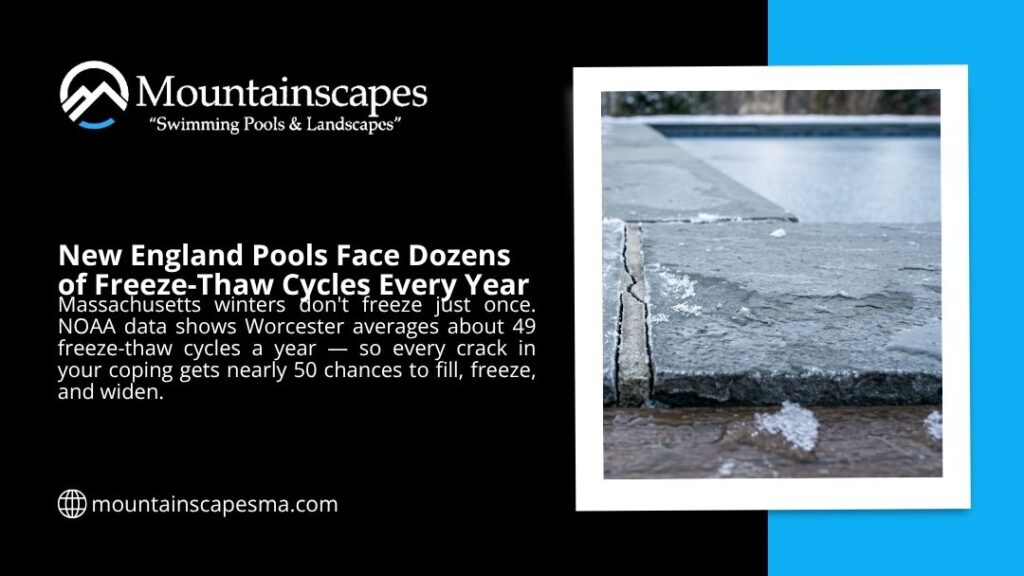
The National Institutes of Health explains the freeze-thaw problem clearly: “The volume of frozen water is 9% greater than liquid water,” according to its technical bulletin on freeze-thaw damage in concrete and brick assemblies. That number matters around a pool. Water enters a crack, freezes, expands, thaws, and then leaves room for more water. After a few New England winters, the crack can widen.
If one small crack stays dry, flat, and stable, it may only need watchful care or a minor repair. If the coping rocks underfoot, grout falls out, the crack grows, water pools near the edge, or tile begins to pop, fix it soon. Waiting through another winter rarely saves money.
| What You See Around the Pool | What It May Mean | What to Do |
| Thin surface crack in one coping stone | Minor age-related wear or material stress | Monitor it, then repair before winter |
| Loose or rocking coping stone | Failed mortar or water under the stone | Fix soon for safety and water control |
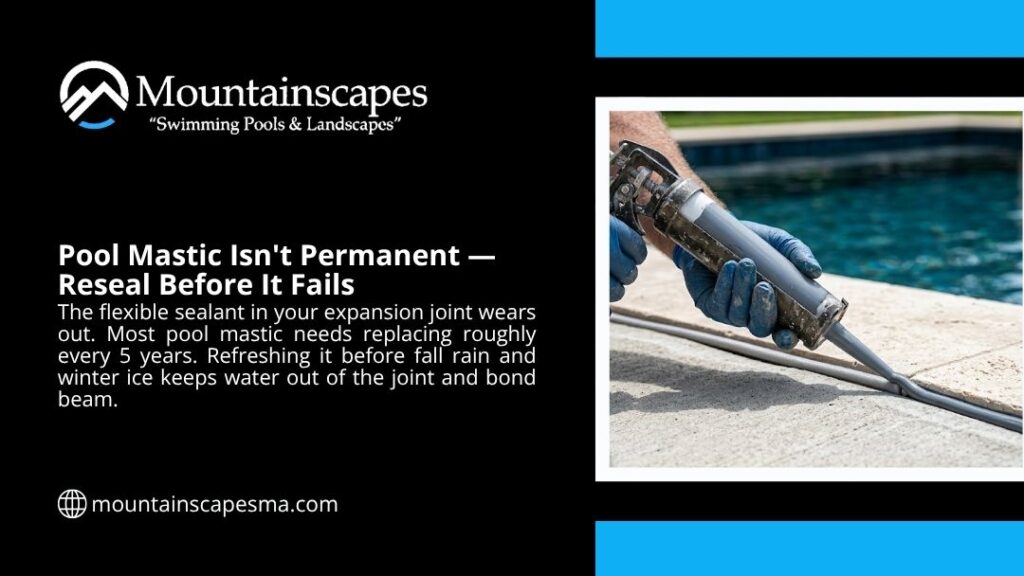
| Gap between deck and coping | Failed expansion joint or old pool mastic | Repair before water gets below the deck |
| Cracked concrete around pool edge | Deck movement, soil settlement, or poor drainage | Inspect before patching |
| Tile popping near coping | Water behind the tile line or stress near the bond beam | Call a professional |
| Same crack returns after repair | Ongoing movement or hidden drainage issue | Diagnose the cause, not just the crack |
Concrete Around Pool Cracking and Pool Deck Movement
Concrete around pool cracking is one of the clearest signs that the coping may not be the only problem. The pool deck and the pool shell should not behave like one solid piece. They need a flexible joint between them so each area can move without pushing against the other.
That joint is often filled with pool mastic, a flexible sealant placed between the coping and the deck. When mastic dries out, pulls away, or cracks, water can enter the gap. Dirt and leaves may pack into it. In winter, trapped water freezes. In summer, heat expands the concrete. Over time, the deck may push against the coping or pull away from it.
That is why cracked concrete around pool areas should not be ignored, especially when the crack runs near the coping line. Yes, concrete cracks. But around a pool, the real question is where the water goes after the crack forms.
If the deck slopes toward the pool, rainwater and splash-out stay near the coping. If the yard has poor drainage, water can sit below the deck and soften the base. If the deck was poured without the right joint detail, the pool and deck may press against each other season after season.
For a homeowner, this can be frustrating. You may think you need swimming pool coping repair, but the real source may be the patio, drainage, grading, or soil below the surface. Mountainscapes’ pool design and build process looks at pool placement, drainage, materials, and surrounding outdoor living features together, which is the better way to prevent repeat damage.
Swimming Pool Coping Repair: Cosmetic Crack or Warning Sign?
Swimming pool coping repair starts with one question: is the crack only in the coping, or is something below it moving?
A cosmetic crack usually affects one stone, one precast section, or a small surface area. The coping still sits flat. It does not move when stepped on. The joint beside it looks intact. The pool is not losing water. The tile line looks steady. In that case, coping repair may involve cleaning the crack, removing loose material, sealing the joint, or replacing one damaged piece.
A warning sign looks different. The coping stone may lift, sink, wobble, or feel sharp. Grout may crumble in several places. A gap may open between the coping and deck. White mineral stains may show up. Tile may start to loosen. A crack may run from the coping down toward the tile line. That kind of crack in pool areas deserves a closer look.
The bond beam is especially important. The bond beam is the reinforced top edge of the pool shell. It helps support the coping and holds the upper part of the pool structure together. If water gets behind the coping and weakens that area, the job can move from simple coping repair to structural pool repair.
That is why quick patch jobs can backfire. They may hide the visible crack while water keeps working below the surface.
| Fix Now | Schedule Soon | Monitor |
| Loose coping, popped tile, sharp edges, widening cracks, water entering open joints | Hairline cracks before winter, failed mastic, small gaps, early mortar loss | Stable, dry, cosmetic surface cracks that do not move or spread |
Here’s the thing: not every crack is an emergency. But every crack is a clue. The smart move is to read the pattern before choosing the repair.
Pool Crack Repair Cost in 2026
Pool crack repair cost depends on the material, the cause, the access, and the amount of hidden damage. A small surface repair may be simple. Resetting several coping stones, repairing the bond beam, replacing tile, or correcting drainage can cost more.
National price references can offer a general baseline rather than a fixed figure. Estimates suggest pool beam repair may average around $75 per linear foot, including tile and coping replacement. In some situations, resurfacing and patching a beam crack can fall in the range of about $4,000 to $5,000.
For local homeowners, the real cost depends on what an inspection finds. Access to the pool, coping material, drainage, deck condition, frost damage, and hidden bond beam issues can all change the scope. Mountainscapes should inspect the pool edge before giving firm repair guidance, because a visible crack may only be part of the story.
| Repair Type | Typical Scope | Cost Level |
| Small coping crack repair | One stable stone or small surface crack | Lower |
| Swimming pool coping repair | Reset or replace loose coping stones and renew joints | Moderate |
| Expansion joint repair | Remove failed mastic and reseal the deck-to-coping joint | Moderate |
| Bond beam repair | Remove coping, repair the top pool edge, reset tile and coping | Higher |
| Drainage plus coping repair | Correct water flow, deck slope, soil, and coping damage | Higher, but more permanent |
A cheap patch that fails after one winter is not cheap. A proper repair protects your investment because it keeps water out of the pool structure and prevents water from turning a small defect into a larger renovation.
If the pool is older, has worn plaster, or needs broader work, it may also help to compare coping repair with future renovation plans. Mountainscapes’ information on how much it costs to build a pool helps homeowners understand how site conditions, materials, grading, lighting, and landscape features affect larger outdoor budgets.
How to Repair Pool Coping Without Making It Worse
How to repair pool coping depends on why it cracked. That may sound obvious, but it is where many repairs go wrong. Filling the visible crack is not the same as fixing the reason it cracked.
A proper inspection looks at the coping stones, deck movement, failed mastic, drainage, mortar, tile line, and bond beam. If a contractor only patches the surface without checking where water goes, the crack may return.
If one stone is damaged, it may need removal and replacement. If the mortar bed has failed, the stone may need to be reset. If the expansion joint is open, old material should be removed and replaced with flexible pool mastic. If the bond beam looks weak, the coping may need to come off so the top edge of the pool shell can be repaired.
Some repairs use polymer-modified mortar. That simply means mortar made with added bonding ingredients so it grips better and handles outdoor conditions more reliably than basic mortar. Other repairs may use pool-rated thinset, fresh grout, flexible sealant, or a sealer suited to the coping material.
What homeowners should avoid is a stiff repair where flexibility is needed. Around a pool, movement is normal. A hard patch in the wrong joint can crack again because it does not let the deck and coping move separately.
| Coping Material | Common Crack Cause | Repair Note |
| Natural stone coping | Freeze-thaw cycles, weak joints, water absorption | May need proper sealing and drainage |
| Precast concrete coping | Age, deck pressure, poor mortar, impact | Damaged pieces may need replacement |
| Brick coping | Mortar decay and trapped water | Joint repair and water control matter |
| Paver coping | Base movement or joint failure | Resetting may work if the base is sound |
| Poured concrete coping | Shrinkage, pressure, poor joint layout | Crack routing, sealing, or section repair may help |

Crack in Pool Shell, Cracks in Pool Plaster, and Pool Plaster Crazing
A crack in the bottom of a concrete pool is different from a cracked coping stone, but the causes can overlap. Soil settlement, poor drainage, and water pressure under the pool can affect the shell, deck, and coping together.
Hydrostatic pressure is one example. In simple terms, hydrostatic pressure means groundwater pushing against the pool shell from the outside or underneath. If that pressure gets high enough, it can stress parts of the pool structure.
Cracks in pool plaster are often surface-level, especially when they look like fine hairlines. Pool plaster crazing, which looks like tiny web-like cracks in the plaster surface, may come from age, curing issues, or water chemistry problems. Pool plaster cracking can start as cosmetic, but if water reaches behind the finish, the repair question changes.
The important point is that pool cracks should be judged by location and behavior. A small plaster crack, a loose coping stone, and a gap at the deck joint may not be three separate problems. They may be three signs of one water or movement issue.
Homeowners should take photos, note the date, and watch for change. If the crack widens, catches a fingernail, leaks, stains, or appears near several loose coping stones, it is time for a professional inspection.
How to Fix Pool Coping in MA and NH Before Winter
How to fix pool coping in Massachusetts and New Hampshire often comes down to timing. Spring and fall are busy seasons for pool and landscape contractors, but fall has a special advantage. It gives homeowners a chance to correct cracks, open joints, failed mastic, and drainage issues before winter freeze-thaw cycles do more damage.
A pool edge that looks fine in September may look worse after March. Water seeps into cracks during fall rain. Leaves hold moisture near the coping. Snow sits on the deck. Then the freeze-thaw cycle starts. By spring, the crack that seemed small may become a loose stone, popped tile, or a wider gap.
Before winter, homeowners should check the coping line, expansion joint, deck slope, nearby drains, and low spots where water collects. If the yard sends water toward the pool, the coping will keep taking damage.
Mountainscapes’ guidance on backyard drainage system warning signs highlights how drainage is often the underlying cause of damage to pools, patios, and hardscapes.
For homeowners who also want to upgrade the patio, repair cracked concrete around pool areas, or rethink the outdoor space, coping repair can pair well with a larger plan. A new pool edge performs better when the patio, grading, planting, lighting, and water flow all work together. Mountainscapes’ landscape design services show how pool areas and surrounding landscapes can be planned as one outdoor living space.
If the crack keeps coming back, it may be time to stop treating it as a pool-only problem. A design-build contractor can look at the pool, patio, drainage, masonry, and landscape as one system.
When to Call a Pool and Landscape Design-Build Contractor
You can monitor a tiny surface crack. You can keep the area clean. You may even handle a small sealant touch-up if you have the correct product. But call a professional when the coping is loose, uneven, sharp, spreading, stained, or tied to drainage problems.
You should also call if the crack returns after a patch. That usually means the repair did not address the cause. Maybe the deck is moving. Maybe water sits under the coping. Maybe the bond beam needs repair. Maybe the pool patio was never pitched the right way. Either way, the pool is telling you something.
A design-build contractor is helpful because coping does not live alone. It touches the pool shell, deck, drainage, grading, masonry, and landscape. Mountainscapes handles custom pools, landscapes, grading, excavation, masonry, and outdoor living projects through one team. Their full services show how those pieces connect.
That single-point approach matters for homeowners. If one contractor repairs coping, another handles drainage, and another replaces the patio, details can get missed. One team that understands the full site can look at the crack and ask the better question: why did it happen here?
For MA and NH homeowners, that can mean fewer surprises, cleaner project coordination, and a repair that lasts longer than a quick surface patch.
Frequently Asked Questions About Cracked Pool Coping
Can cracked pool coping cause leaks?
Cracked pool coping does not always cause a pool leak, but it can let water enter joints, mortar beds, tile areas, or the bond beam. If water keeps moving behind the pool edge, it may lead to loose tile, weakened mortar, or structural damage over time.
Can I repair pool coping myself?
A homeowner may be able to handle a tiny sealant touch-up, but loose coping stones, open joints, popped tile, or cracks that keep returning need a professional. The risk is that a surface repair may hide the real cause.
Should pool coping cracks be fixed before winter?
Yes, in most cases. In Massachusetts and New Hampshire, cracks should be repaired before winter if water can enter them. Freeze-thaw cycles can widen cracks and turn small coping repair into tile, deck, or bond beam work.
How long does coping repair last?
A good coping repair can last for years when the cause is fixed. If the repair only covers the crack but ignores drainage, deck movement, or failed mastic, the damage may return after one or two seasons.
Is cracked coping a structural problem?
Sometimes it is cosmetic. Sometimes it is a warning sign. If the coping is loose, uneven, spreading, stained, or near popped tile, the pool structure should be inspected. The bond beam, which supports the upper pool edge, may need attention.
Protect the Pool Edge Before the Damage Spreads
What causes pool coping to crack and when to fix it comes back to water, movement, and timing. Pool coping can crack from freeze-thaw cycles, worn mortar, failed mastic, soil settlement, poor drainage, deck pressure, aging coping materials, or stress near the bond beam.
The right time to fix it is before water gets deeper into the structure, before winter expands the crack, and before a simple repair turns into a larger renovation. A small crack in pool coping may not ruin your pool. Ignoring it might.
If your pool edge is cracked, loose, uneven, or letting water in, have the full area checked before you patch it. Mountainscapes helps MA and NH homeowners design, repair, and build outdoor spaces with pools, landscapes, drainage, hardscapes, and grading handled together. To talk through your pool coping, pool deck, or backyard renovation project, schedule a site visit.